





February 16, 2023
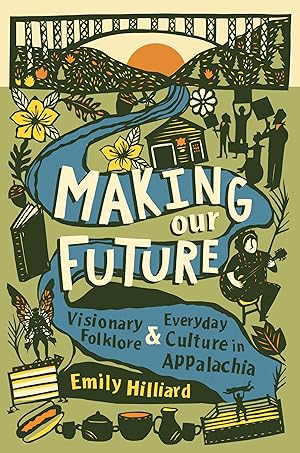
Emily Hilliard's Playlist for Her Book "Making Our Future"
In the Book Notes series, authors create and discuss a music playlist that relates in some way to their recently published book.
Previous contributors include Jesmyn Ward, Lauren Groff, Bret Easton Ellis, Celeste Ng, T.C. Boyle, Dana Spiotta, Amy Bloom, Aimee Bender, Roxane Gay, and many others.
Emily Hilliard's Making Our Future: Visionary Folklore and Everyday Culture in Appalachia is a fascinating exploration of folklife in West Virginia as well as the role folklore plays in culture.
The Southern Review of Books wrote of the book:
"A fascinating example of folklore fieldwork in West Virginia. People from the state . . . will find places and concepts they recognize thoughtfully and respectfully represented, and outsiders will gain an understanding of the deeply complex and communal past and present of the Mountain State."
In her own words, here is Emily Hilliard's Book Notes music playlist for her book Making Our Future: Visionary Folklore and Everyday Culture in Appalachia:
Though in Making Our Future: Visionary Folklore and Everyday Culture in Appalachia there is only one chapter expressly devoted to music, music runs throughout the book, much as it does through all of the West Virginia folkways practices the book traces—from the gospel group Flying Colors of the multiracial, multiethnic coal camp community Scotts Run, to the Tom Petty, Rihanna, and Twisted Sister songs that West Virginia educators sang during the 2018-2019 Teachers’ Strike, to the square dance held under an effigy of Old Man Winter during the Swiss town of Helvetia’s annual pre-Lenten festival. And at the culmination of nearly every event or celebration, there’s “Country Roads”— In West Virginia there is always “Country Roads.” Though many of the songs on this playlist link directly to chapters in the book, others have a more abstract connection—providing an ideal sonic atmosphere for the book to be read. Most are by West Virginians.
“They’ll Never Keep Us Down” - Hazel Dickens
Themes of labor run across the disparate chapters in Making Our Future—from the “curb girls” who work often low-wage precarious jobs at West Virginia’s beloved hot dog joints, to local professional wrestlers who identify as workers, to a full chapter on the expressive culture of the 2018 West Virginia Teachers’ Strike. West Virginia’s own Hazel Dickens was not just an advocate for working people—from Appalachia and beyond—but wrote from her own experience as a worker. One of the teachers' strike signs that appears in the book quotes this song with a choice edit: “We won’t be bought/We won’t be sold/ To be treated right and fix PEIA*/ Well that’s our goal.
*The state-sponsored health insurance that was at the center of the educators’ demands during the strike.
“Grandma’s Hands” - Bill Withers
Is Bill Withers the most famous musician son of a West Virginia coal miner? Probably so. I believe this song is about his grandmother Grackus Monroe Galloway, who was born enslaved and who Withers was close with as a child growing up in Raleigh County, West Virginia.
“Castles in the Air” - Grandpa Jones
This song was written by West Virginia native Shirley Campbell (1949-2021), the sister-in-law of old-time musician Ola Belle Reed and one of four women whose music is featured in the chapter, “So I May Write of All These Things,” on the private, familial, and/or communal creative practice of nonprofessional women songwriters in West Virginia. Shirley was a teenager when she wrote it and her father took it down to Nashville and pitched it to Jones. She is credited on the Grandpa Jones 1970 live album it appears on as “Shirley White.”
“No More Hot Dogs” - Hasil Adkins
When I first moved to West Virginia in 2015, I quickly learned that hot dogs were really important in the state. Everyone seemed to have an opinion about who made the best ones and what went on a West Virginia hot dog (generally chili, slaw, mustard, and onions, unless you are north of the “Slaw Line,” which is sort of like a Mason-Dixon of condiments). I would be doing fieldwork in a tiny town in the coalfields, and there would be a cement-block business claiming to have the “Best Hot Dogs in Town.” Boone County, West Virginia native Hasil Adkins (whose hometown of Madison is highlighted in the wrestling chapter) has apparently had his fill.
“One Day More” - Elaine Purkey
Labor songwriter Elaine Purkey (1949-2020) of Lincoln County, West Virginia is also featured in the women’s nonprofessional songwriter chapter. Elaine wrote “One Day More” in twelve minutes on her way to a rally for union steelworkers at the Ravenswood Aluminum plant in Jackson County, West Virginia after they were locked out by the company and replaced with non-union scabs. The song appears on Smithsonian Folkways’ Classic Labor Songs, in the liner notes of which Elaine writes, “No matter how long the company or the corporations can stick around, we have enough strength, friendship and camaraderie about us and belief in what we’re doing, we can be there one day more; whatever they do, we’ll be there the day after.”
“Fisher’s Hornpipe” - John Morris
I had to include a song from my friend John Morris, a fiddler, guitar and banjo player, and songwriter from Clay County, West Virginia, and a 2020 NEA National Heritage Fellow. John and his brother David saw traditional mountain culture as a source of empowerment for Appalachian people in their struggle against exploitation by the mining industry, and in the late ‘60s and early ‘70s hosted the Morris Family Old-Time Music Festival at their family home place. That festival model, located in the rural areas where the tradition and its practitioners lived and which encouraged sharing between locals and outsiders, young and old, became the gold standard for a community-based traditional music festival in Appalachia. This tune came to John from Clay County fiddler Ira Mullins.
“Count On Me” - Cora Hairston
Cora Hairston, another one of four women featured in the nonprofessional women’s songwriter chapter, is a musician, songwriter, and author, who has written two fictionalized accounts of her childhood growing up in a Black coal camp in Logan County, West Virginia, Faces behind the Dust: The Story Told Through the Eyes of a Coal Miner’s Daughter (on the Black Side) and Hello World, Here Comes Claraby Rose: An Adolescent Black Girl Coming of Age. Though she practices her songs daily as part of her regular devotional practice, I was thrilled that she finally recorded an album of her original songs this year for all to enjoy.
“People Have the Power” - Patti Smith
With its message of the power of people working together creatively as a collective, this song could be an anthem for all of Making Our Future. What a lot of people outside the state don’t know is that one of the song’s writers, Fred Sonic Smith, was born in West Virginia (very close, in fact, to where Elaine Purkey was born and lived all her life). For both those reasons, I think of this as a very West Virginia song.
“Links on the Chain” - Phil Ochs
Phil Ochs was writer Breece D’J Pancake’s favorite musician. Chapter 4, “Something Deeply Rooted,” explores the invisible landscape of Pancake’s hometown of Milton and the settings which inspired many of his short stories. I don’t know which Phil Ochs’ songs Pancake was especially partial to, but as he was a Wobbly for a stint and references William Haywood and “The One Big Union,” in his story “The Honored Dead,” this one feels like it could have been a favorite.
“Wild West Virginia” - Daniel Johnston
There’s a common trope in songs about West Virginia in that most of them are written from the position of someone who is no longer living in the state, but wants to go home. This is true of the last three songs on this mix, including this one by Daniel Johnston, the visual artist and lo-fi alt musician who grew up in the northern panhandle. He does sing in the lyrics that he doesn’t like John Denver—sorry, Daniel.
“Take Me Home Country Roads” - John Denver
I was unloading the Uhaul to move into my first apartment in Charleston, and within 15 minutes heard a crowd singing “Country Roads.” Though it’s often mentioned that the song wasn’t really written about the state, it is truly a song that is sung and heard all the time in West Virginia, as a group sing-along culmination to many activities—protests, sporting events, bonfires, bar karaoke. I have to say, I’ve become partial to it, as now it evokes those collective experiences, of for example, a sea of striking teachers and public service employees all wearing red, with their arms around each other, singing and swaying on the steps of the state capitol as they fight for better benefits, working conditions, and futures of their students and communities.
“West Virginia, My Home” - Hazel Dickens
Any John Denver merits a Hazel Dickens chaser, and I do wish her “West Virginia, My Home” got at least as much airtime as “Country Roads."
Emily Hilliard is a folklorist and writer based in central Appalachia. She is the former West Virginia state folklorist and the founding director of the West Virginia Folklife Program. Find more of her work at emilyehilliard.com.
If you appreciate the work that goes into Largehearted Boy, please consider making a donation.
February 16, 2023
Shorties (Mai Nardone Interviewed, New Music by Bully, and more)
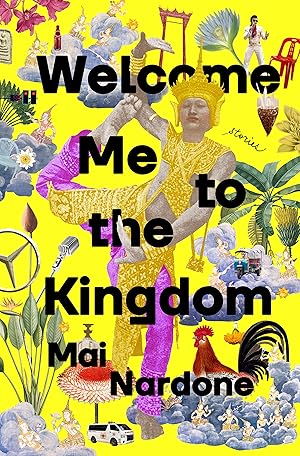
Mai Nardone discussed his new story collection Welcome Me to the Kingdom with Electric Literature.
What I liked about the title is that it can sound like a plea and it can also sound like a demand, a kind of insistence. The title story is about two women who are trying to find their place in the world geographically and also socially. One is older and one is much younger; it’s the younger one who is reeling from dislocation. In that particular story “the kingdom” is the men’s world of gambling. The title is the older woman joking about entering that kingdom.
Stream a new song by Bully.
eBooks on sale for $1.99 today:
Ariel by Sylvia Plath
Pie School by Kate Lebo
eBook on sale for $3.99 today:
Pitchfork profiled Jamal Alnasr, owner of NYC's Village Revival Records.
Alnasr’s lack of filter and stubborn sensibility give Village Revival a gritty, old-school New York charm.
Carmen Maria Machado recommended the best scene she has ever read at Vulture.
Stream three new songs by Bill Orcutt.
Literary Hub shared Domenica Ruta's contribution to the anthology Wanting: Women Writing about Desire.
Stream a new song by Mega Bog.
Sarah Watling recommended neglected books about the Spanish Civil War at the Guardian.
Stream a new Natalie Merchant song.
Camonghne Felix talked to Shondaland about her memoir Dyscalculia.
In poetry, cliché is assumed. If you study poetry, you know that cliché is actually not a bad thing. Cliché is about familiarity. One of the things you want most in a poem is some familiarity, some sense of it. Ultimately with this book, I realized that because I was not specifically writing poems and I was writing in prose, I could take advantage of the cliché in a more unique way, and to speak in physiological terms, I took the cliché and spread it out and spread it as thin as possible.
Stream a new John Vanderslice song.
Debutiful interviewed author Daisy Alpert Florin.
UPROXX interviewed singer-songwriter Shalom.
What are four words you would use to describe your music?
Honest, interesting, alternative, emotive
Courtney Maum discussed how to write a book proposal at the OTHERPPL podcast.
Stream a new song by Brìghde Chaimbeul.
Mary Ruefle shared an essay on fear at Poetry.
Stream a new song by Eternal Summers’ Nicole Yun.
Stephen Markley wrote about writers' failures at the New York Times.
The Quietus shared a conversation between Franklin James Fisher and Ryan Mahan of Algiers and Backxwash's Ashanti Mutinta.
The OTHERPPL podcast interviewed author Chetna Maroo.
Stream a new song by Jonnine Standish.
Stream a new song by Yours Are The Only Ears.
Stream a new song by Joanne Robertson.
Stream a new song by Anna B Savage.
Aquarium Drunkard interviewed singer-songwriter Mac DeMarco.
Stream a new Xiu Xiu song.
If you appreciate the work that goes into Largehearted Boy, please consider making a donation.
February 15, 2023
Jesica Fields' Playlist for Her Poetry Collection "When a Grasshopper Whispers"

In the Book Notes series, authors create and discuss a music playlist that relates in some way to their recently published book.
Previous contributors include Jesmyn Ward, Lauren Groff, Bret Easton Ellis, Celeste Ng, T.C. Boyle, Dana Spiotta, Amy Bloom, Aimee Bender, Roxane Gay, and many others.
Jesica Fields' collection When a Grasshopper Whispers is filled with poems of trauma and survival.
In her own words, here is Jesica Fields' Book Notes music playlist for her poetry collection When a Grasshopper Whispers:
Kelly Clarkson | Because of You
The collection begins with poems about childhood. The limiting beliefs that are set upon us from a very young age and how we learned to cope with them. Sometimes our coping skills create patterns of negative behaviors. Waking Up describes this feeling of realization that our toxic environments can be literal hell on Earth. Kelly Clarkson’s song "Because of You" touches on childhood emotional neglect and the traumas attached to self-love, security, and trust.
Billy Gilman | One Voice
The overall theme of When a Grasshopper Whispers is to allow the reader to see even the smallest voices can make a big impact. I am very soft-spoken, but through writing, I have this powerful tool that allows me to connect with others and make a change in the world. "One Voice" has been a favorite song of mine since childhood. I’ve always felt like I was on this hero’s journey to find my own voice and make an impact in the world.
Zoe Weiss | Control
Throughout the book, I address several mental health issues like anxiety and depression. The reader goes on a rollercoaster of mixed emotions as I face an internal battle with mental health. "Neurotypical Nightmares" is one of my favorite poems in the collection. It really embodies this song because I describe how if left untreated depression can take over and we lose control of our lives.
Jimmy Eats World | The Middle
Suicidal thoughts are very prevalent in this collection. I address hopelessness like a ledge I’m clinging onto. "Shel Silverstein was right about the Sidewalk," a poem that brings the whimsy of childhood into real adult feelings of separation from self. It questions and challenges everything we’ve come to believe about a life well lived. I chose the song "The Middle" because it has saved me from myself more times than I’d like to admit. Its upbeat tempo and positive affirmations about holding on have always lifted my spirit. I always tell myself: “These feelings are not forever, it’s just for now.” And I think that’s important for all of us to remember, that we’re more than our thoughts.
Selena Gomez | Lose you to Love me
I think the act of letting go is the most enlightening and painful thing we can experience in life. "I am Worthy" is my letting go poem. In this piece, I address all the physical aspects of life that I had to release in order to find my authentic self. This song is an anthem of self-love and learning the important life lessons that shape who we are.
Marshmello | Happier
There comes a point in this healing journey where our old self looks at the newly evolved self and realizes that the ego must die in order to reach a happier and more peaceful place. Tower Moments is one of my more metaphorical poems. I tell a story of a lighthouse (the physical body) and the light it shines (the spirit) and how we must keep our spirit intact even as our world is crumbling around us. "Happier" is a song that takes a similar journey. I interpret it as our past selves telling our present selves that in order to be happy we must forget about the past and live in the present.
The Score | Victorious
This is my daily pump-up song. I love turning it on full blast each morning to remind myself that I can overcome all challenges in life. A Bitter Sour talks about this very concept of having all odds against you, but choosing to rise anyway. “Watch the way I soar with uncertainty, plummeting in a spiral to quickly catch myself and rise higher. Far from majestic, but a fighter.” This underlying theme of hope is what I love most about my collection. I’m honest about my experiences, but I never leave the reader without a glimmer of hope, resolution, or self-reflection.
Alan Walker | Faded
Alan Walker is one of my favorite music composers. I love the esoteric sound and deep-rooted meanings behind his songs. "Faded" talks about being lost in the physical world and searching for something spiritual to grab onto. Homesick is one of my more ethereal poems. It talks about my desire to “go home” to myself. To shed all aspects of the physical world and just float as energy in the ether. I predict my future collections will take a deeper dive into this similar theme; as I’m always questioning and searching for the true meaning of life.
Eminem | Not Afraid
No song list would be complete without the lyricism of Eminem (in my humble opinion). "Not Afraid" tells a story of Marshall Mather’s rise out of the darkness and into the light. He takes on a personification and responsibility to guide the collective out of pain and suffering. I look at my poetry book in a similar light. I share everything I’ve learned so far about life, love, and pain in order to transcend into my highest self, in hopes someone will learn from my experiences and apply the lessons to their own lives. I think the key to this is not having fear of speaking out about the things that have wounded us the most.
P.O.D | Alive
This song takes me right back to middle school when studded belts and black fishnet gloves were a thing. But don’t let the heavy metal fool you, this song is all about having faith and being true to yourself. "I Contact" is the first poem in the book that gives a nod to the importance of spirituality in humanity. I think it’s less about what an individual believes and more about knowing the spiritual truths that connect each one of us. I like to take concepts from all religions that best resonate with my vibration and create an alchemy of love that I put forth through my writing.
Danny Gokey | Masterpiece
I find this song to be incredibly beautiful and it brings me peace of mind each time I listen. It’s the knowing that some force within us is working to change our reality. I talk about darkness a lot in this book. Something I’ve had to learn along the way is that the darkness is the very thing that shapes us. Just like waves in the ocean, we need the ups and downs in life to keep everything in balance. "Gratitude in Turmoil" talks about this very concept. How we can use our setbacks as a moment to learn where we need to pivot in life. And honoring the hardships as much as we celebrate the success.
Enigma | Return to Innocence
As the collection comes to a close I like to interpret the final poems as a figurative re-birth. I laid out all the foundations of my life’s trauma. All the things that at one point in time broke my emotional spirit. Having written them, those things no longer belong to me. I’ve now released them to the world without fear or judgment of myself. I’m free to continue on to my next chapter as my authentic self without the weight of past trauma.
Jesica Fields, also known as The Soft-Spoken Poet, is a poet from central Texas. Her priority with writing is to provide an emotional alchemy through a combination of storytelling, poetry, and multimedia art.
If you appreciate the work that goes into Largehearted Boy, please consider making a donation.
Shorties (An Excerpt from Sonora Jha's New Novel, New Music from PONY, and more)

Literary Hub shared an excerpt from Sonora Jha's novel The Laughter.
Stream a new song by PONY.
eBooks on sale for $3.99 today:
The Last Holiday by Gil Scott-Heron
The White Album by Joan Didion
eBook on sale for $4.99 today:
Italian Folktales by Italo Calvino
The Vapors' Dave Fenton discussed the band's hit "Turning Japanese" with the Guardian.
When people ask if the song’s become an albatross, I say no. I’m pleased it happened to us. I’d rather be a one-hit wonder than a no-hit wonder.
The Beat shared an excerpt from Rob Kirby's graphic memoir Marry Me a Little.
Michele Catalano shared a playlist of love songs.
Book Riot and Literary Hub recommended the week's best new books.
Paste ranked Paramore's albums.
The New Statesman recommended books to understand Putin's Russia.
Stream a new song by Lana Del Rey.
Public Books reconsidered the poetry of Samuel Taylor Coleridge on his 250th birthday.
Stream three new songs by Feist.
Jennifer Savran Kelly recommended novels about finding purpose through someone else at Electric Literature.
Bandcamp Daily shared a guide to Yo La Tengo's discography on Matador Records.
Malcolm Harris talked to Kirkus about his book Palo Alto: A History of California, Capitalism, and the World.
Stream a new song by Beabadoobee.
Tricycle interviewed David Sedaris.
Stream two new songs by Island of Love.
Asale Angel-Ajani discussed her novel A Country You Can Leave with Literary Hub.
Stream two new Dry Cleaning songs.
Vol. 1 Brooklyn interviewed author Paul Tremblay.
Snail Mail covered Talking Heads’ “This Must Be The Place (Naive Melody)” with Mac DeMarco.
Minorities in Publishing interviewed author Kashana Cauley.
Stream a new song by crushed.
This Is Horror interviewed author Stephen Graham Jones.
If you appreciate the work that goes into Largehearted Boy, please consider making a donation.
February 14, 2023
Anne K. Yoder's Playlist for Her Novel "The Enhancers"

In the Book Notes series, authors create and discuss a music playlist that relates in some way to their recently published book.
Previous contributors include Jesmyn Ward, Lauren Groff, Bret Easton Ellis, Celeste Ng, T.C. Boyle, Dana Spiotta, Amy Bloom, Aimee Bender, Roxane Gay, and many others.
Anne K. Yoder's novel The Enhancers is a smart, surprising, and imaginative debut.
Patrick Cottrell wrote of the book:
"Animated by the absurdity of a Yorgos Lanthimos film, The Enhancers is a wildly original and contemporary tale about chemical augmentation, memory, yearning, and loss. Imagine the fearlessness and wild imagination of Jenny Erpenbeck if she had a background in the pharmaceutical industry and you might come close to approximating the tremendous brilliance of Anne Yoder."
In her own words, here is Anne K. Yoder's Book Notes music playlist for her novel The Enhancers:
I wouldn’t underestimate the effect that attending university in Athens, Georgia in the mid to late nineties had on the shape of my life— I was a mess at the time. I'd nearly been set up to fumble through my college years, which I proceeded to do in my own lost and peculiar way. The one saving grace during my time in undergrad was Athens’ music and arts scene. Michael Stipe was a fixture at local haunts, and although I never saw him play in Athens proper, I could walk a few blocks downtown or get a ride into Atlanta and see Radiohead, Vic Chesnutt, Mazzy Star, Jesus and Mary Chain, Jucifer, Man or Astroman, The Make-Up, Sonic Youth, Run DMC, Pavement, Fugazi, all varieties of Elephant Six, and so many others. Music was central to my life as a teenager, especially, so that writing a playlist for The Enhancers now seems like second nature. I often listen to music while I write — it’s as if the music I'm drawn to when writing helps articulate the mood on the page. If there was any single album that set the mood for The Enhancers, it was Darkside’s 2013 album, Psychic, with its ominous immersive quality. In the first days of drafting the manuscript, I often tuned in to its alienlike ambience that isn’t “looking for a heart to heart so much as a telepathic exchange,” as Pitchfork reviewer Ian Cohen writes. Hannah, The Enhancers’ central character, and one of the novel's many narrators, isn't able to articulate or even really know what she feels, so perhaps an attempt at telepathy is her best option. Regardless, these songs form their own journey. Sit back, swallow a handful or mugful or whateverful of your chemical of choice, and listen up.
Blackalicious, Chemical Calisthenics
Blackalicious’ Gift of Gab could’ve made anything, including the periodic table of elements, into a smooth buttery rhyme. “Chemical Calisthenics” is a song about all types of energy, the basic particles that make up the world: “Dried ice, C-O squared refrigerant / N-O-2 makes you laugh, it’s laughing gas used by dentists / I nearly added acid glue, I’m like oil / of a toil, the king of chemicals / And the G hear gas waved all your mats.” This is the world of The Enhancers in a nutshell. It's our world too. Is this the art that Lumena Hills would embrace? Oh yeah. But Blackalicious has all of the cool with none of the hang-ups or oppression. He’s just nerding out on his own verbal precociousness, like: “I’m cookin a potion, cool.”
The Fall, Mr. Pharmacist
The pervasiveness of the pills! There’s much supplication to the pill-loose pharmacist when Mark E Smith sings: “Mr. Pharmacist can you help me out today in your usual lovely way?” The Fall wrote and sang this plea / encomium to Mr. Pharmacist in a world where the pharmacist is a bribable gatekeeper to the good stuff. But in Lumena Hills, “Mr. Pharmacist” could be the soundtrack for its dispensaries at every corner— a theme song that encourages the residents take pride in their chemically advanced ways. “Mr. Pharmacist” delights me again and again, and it seems I unwittingly named a supplement for this song (Liquid EnerG and, another variation, InnerG) as the song ends: “Won’t you please give me some ENERG!”
Radiohead, Fitter, Happier
A few friends have commented that The Enhancers is simultaneously future-forward and a throwback to being a teen in the nineties. That’s also an apt description of the track “Fitter, Happier” on Radiohead’s OK Computer which debuted nearly 25 years ago, though is still contemporary in this post-humanist age. Optimize self-care, optimize performance, can humans compete with AI — artistically? algorithmically? This too reflects the essence of culture in Lumena Hills, so preoccupied with controlling and optimizing emotions, safety, longevity, efficacy while completely devoid of feeling and life.
Angel Bat Dawid, We Are Starzz
This one’s for Harold, who works in an aging astrophysics lab, and because of whom Hannah thinks about stardust, with whom we share our chemical makeup, It’s not explicitly a lamentation but feels like one when Dawid sings: “We are glowing stars, shining brightly.” There are so many registers to Dawid’s voice, and when listening to her music I feel a sense of convergence with the infinite.
Sun Ra, Nuclear War
“Nuclear War” is paradoxically the most chill song about radiation, mutation, and the omnipresent anxiety about our manmade capacity for destroying the planet: “It’s a motherfucker, don’t you know.” Nuclear war isn’t the pervasive threat in The Enhancers, but Hannah has great anxiety about manmade and imminent catastrophe— climate change and species extinction, her generations’ imminent threat. As Sun Ra says, “What'cha gonna do? Without your ass?”
Elf Power, Artificial Countrysides
This one’s for the spa trip that Hannah takes with her mother to Spa L’Cran Noir, a compound that’s manufactured to appear like a desert spa, with its famous black sands, mud baths, cleanses, detoxes, and sensory deprivation tanks. But none of this is naturally occurring. In Lumena, even ‘natural’ products are patented, and often synthetic or artificial in their own way. The song sounds deceptively upbeat: “Artificial countrysides that never / rot and don’t decay / growing faster all the time / spreading further everyday.”
La Femme, (Plaisir XV)
I can’t listen to this song without wanting to conduct an orgy with the world, or at least in the back corner of a La Femme show, which is as imminently seductive if not moreso when playing this song live. “Plaisir XV”’s sonic vibrations are all pleasure, eroticism, and ear candy. The song’s delectable vocals, its incantatory beat, its background cum moans are Delixir’s—the erotic pleasure-inducing tab’s— musical equivalent.
Firewater, Psychopharmacology
If The Fall’s “Mr. Pharmacist” is essentially Lumena Hills’ theme song, Firewater’s “Psychopharmacology” is teen protagonist Hannah Marcus’ ironic retort. What she needs isn’t more pills but acknowledgment that her grief with regard to climate disaster and mass extinction is real. Firewater sings of Hannah’s baseline on mental augmentation, VALEDICTORIAN: “The endless shrink parade, the nights that never cease, and all you want is peace, but all you get is pills, and still they tell you that psychopharmacology is going to be your friend when you can’t get out of bed and you’re so tired of pretending.”
Crystal Castles, Fainting Spells
The electro fuzz of “Fainting Spells” is the white noise and buzz is exactly what I imagine the state of Hannah’s and Celia’s minds with their mental compromise and fallout from taking VALEDICTORIAN.
Of Montreal, Heimdalsgate Like a Promethean Curse
The suite of songs that kick off Hissing Fauna Are You the Destroyer are all about friendship, abandonment, depression, drugs, bottoming out, and pleading to the chemical gods to not make it worse. This feels like a readymade for Hannah Marcus as she finds her way through third year, certainly as soon as VALEDICTORIAN starts messing up her mind. Particularly poignant is Kevin Barnes’ shift from party mode to crisis mode in “Heimdalsgate Like a Promethean Curse,” pleading that the meds don’t make it worse: “ Chemicals don’t flatten my mind / Chemicals don’t mess me up this time / Know you bait me way more than you should / And it’s just like you to hurt me when I’m feeling good. Come on Chemicals!”
Bjork, Cvalda
I haven’t thought about sound and music in the same way since I first saw Bjork in the role of Selma in Dancer in the Dark, as a factory worker who among the squeals and hisses of the machines breaks into song and dance with her coworkers. The drudgery of the work turns into something closer to magic as the machines create a rhythm with their whir and grind that creates the tempo and beat over which Bjork sings, crackles, and coos. I’d like to think that the factory-centric chapters of this book would have a similar type of soundtrack comprised of the sounds of the production line.
Pink Floyd, Breathe (In the Air)
The air becomes tainted with the factory fire, though it’s not like it’s always safe to breathe in Lumena Hills anyway. This is the beginning of Hannah’s experience beyond the town, and where her life begins to open up to other possibilities. Instead of digging hole after hole, or its equivalent working in R&D, Hannah may have other possibilities. She begins to realize, as David Gilmour sings, “all you touch and all you see / is all your life will ever be.”
Arthur Russell, Being it
To continue with the idea of awareness and presence in a Be Here Now kind of way, we bring in Arthur Russell’s “Being It,” a loosely structured song about travel, leaving, bridges, crossing over, leaving: “But being isn’t certain … It is on the bridges / Get away / Soon to go away.”
Tindersticks, Show Me Everything
Tindersticks makes such dramatic soundscapes (they’re also a longtime collaborator with director Claire Denis). I read this song as a plea to learn all, the good and the treacheries, to see the world for what it is not what Hannah or Lumena Hills wants it to be. This is what Hannah is discovering toward the end of the novel. And even in this darkness there is a shard of hope: “(Show me, show me) / All the mess, all the wrong turns / We could take these stones, we could build something.”
Hole Rock Star
An apt accompaniment for the last chapter of the novel, as Hannah watches her classmates graduate while her life is set to take a different trajectory. I won’t say more to avoid spoilers, but Courtney Love’s spiteful primal screech, “Come on, make me sick / Come on make me real,” in response to the sleepwalking emptiness and conformity is on the level of Hannah’s contempt. Love’s raw anger could provide a channel for Hannah’s self-expression, an opening.
Anne K. Yoder's fiction, essays, and criticism have appeared in Fence, BOMB, Tin House, NY Tyrant, and MAKE, among other publications. She writes, lives, and occasionally dispenses pharmaceuticals in Chicago.
If you appreciate the work that goes into Largehearted Boy, please consider making a donation.
Shorties (A Previously Unpublished Interview with Clarice Lispector, Ruhail Qaisar on His Debut Album, and more)

The New Yorker shared a previously unpublished interview with Clarice Lispector.
Ruhail Qaisar discussed his debut album Fatima with The Quietus.
Time takes on a strange character in Fatima. Field recordings capture moments in time (dogs bark, children chatter), which float amidst time-warped samples and alien, atemporal drone. Qaisar suggests this was influenced by the way Fatima’s creation took place in the contrasting environments of rural Leh and the claustrophobic apartment he keeps in New Delhi. “Urban life out there is very straining. When I get home to Leh and look at the landscape, it feels like time works differently.”
eBook on sale for $1.99 today:
The Body Scout by Lincoln Michel
eBook on sale for $3.99 today:
Paste profiled the band Girl Scout.
Girl Scout’s jazz roots are not immediately evident on Real Life Human Garbage. As Jansson says herself, you don’t hear the arrangements on “Weirdo” and think, “Oh, that’s jazz.” Instead, it’s a structural and technical influence, as the average jazz song often jumps between two or three keys. Understanding how to navigate harmonics was a crash course that really helped spread out what kind of sounds the band could make.
Kieran Goddard recommended books where work seeps into everyday life at Electric Literature.
Stream a new song by the Lemon Twigs.
The Atlantic recommended books to read as a pair.
The Oxford American reconsidered Millie Jackson's country album, Just a Lil’ Bit Country, 40 years after its release.
Just a Lil’ Bit Country has also never sounded more important. I hear it as a link in the long and ongoing history of how African American musicians have added new chapters in country’s development rather than simply serving as static influences from a semi-mythical past.
Heinz Insu Fenkl recommended books with themes of spirituality and growth at The Week.
Pitchfork remembered De La Soul’s Trugoy the Dove with six songs.
Karen Russell talked writing for the stage with Esquire.
Bandcamp Daily recommended instrumental doom metal albums.
The Gotham Book Prize has announced its 2023 finalists.
PopMatters shared an alternative Valentine's Day playlist.
Eugen Bacon and Andrew Hook discussed collaborating on their book Secondhand Daylight at Vol. 1 Brooklyn.
Stream a new song by Avey Tare.
Rain Taxi shared a conversation between authors Madison Smartt Bell and Jane Deleur.
Akwaeke Emezi has launched an Instagram account dedicated to their visual art.
Stream a new Deerhoof song.
If you appreciate the work that goes into Largehearted Boy, please consider making a donation.
February 13, 2023
Curtis White's Playlist for His Book "Transcendent"

In the Book Notes series, authors create and discuss a music playlist that relates in some way to their recently published book.
Previous contributors include Jesmyn Ward, Lauren Groff, Bret Easton Ellis, Celeste Ng, T.C. Boyle, Dana Spiotta, Amy Bloom, Aimee Bender, Roxane Gay, and many others.
Curtis White's Transcendent: Art and Dharma in a Time of Collapse is an smart and timely exploration of the West's fascination with Buddhism.
Publishers Weekly wrote of the book:
"Provocative...[Transcendent] amounts to a convincing case that will resonate with progressives seeking to 'free ourselves from the [capitalistic] world that we were born into' and 'change the way we live.' Scholars of Buddhism will benefit from White’s shrewd takes."
In his own words, here is Curtis White's Book Notes music playlist for his book Transcendent: Art and Dharma in a Time of Collapse:
Given the nature of my new book, this playlist writes itself. I say that because much of Transcendent is about music and music’s endearing ability to provide pleasures that are so intense that they border on the mystical, or at least the mysterious.
Father John Misty, “Hollywood Forever Cemetery Sings”
I open the book by wondering why my sense of the best cuts on Father John Misty’s 2012 album, Fear Fun, so nearly reflects the judgment of some fifty million fellow listeners on Spotify. Is it our biology, something in the song that trips a dopamine trigger? Or, worse, is it merely that the song is an algorhythmic hit, a contagion of repeat listens that is finally empty of meaning? Or is it something more mysterious than that? As Hua Hsu observes in his new book Stay True, “I finally felt in my body how music works. A chorus of nonbelievers, channeling God.”
Idles, “1049 Gotho”
Musical transcendence takes many forms. It’s not all about channeling God. There is also social transcendence in music. Music can ask us to rise up and retake our lives from what oppresses us. The neo-punk band Idles thrashes the conventional in order to make way for freedom and kindness. Really loud kindness.
Thelonius Monk, “Monk’s Point”
As Martin Williams writes in the liner notes to the album Solo Monk, “’Monk’s Point’ is the most refined example I have ever heard of Monk’s way of bending a piano note—not of slurring together two successive notes, but actually producing a continuous curve of sound—an impossible technique.” In this way Monk creates a musical beyond. Like a Buddhist adept, he says, “Silence is the loudest noise.”
Mommas and the Papas, “Young Girls are Coming to the Canyon”
There is an essay in Transcendence titled “Music’s Music” in which I suggest that what is beyond musical communication or pleasure is music’s Music, what jazz bassist Victor Wooten confesses to in saying, “I listened to Music in the past but only in a one-sided way. I only listened to what I wanted to hear, not what Music had to say.” This old Top 40 tune by the Mommas and the Papas may seem a strange song to illustrate Wooten’s point, but transcendence can happen even within the products of the music industry. After a single meditative opening verse, “Young Girls” suddenly surges forward—without a bridge, just the briefest crescendo from the drums—surges on a chorus of startling power, as if they’d just been listening to Handel’s Hallelujah Chorus: “Young girls are coming to the ca-a-anyon!”
Gustave Mahler, Kindertotenlieder #1: Nun will die Sonn‘ so hell aufgeh’n“
Sad beyond sadness, beautiful beyond beauty, and transforming, this is Mahler at his most spiritual. The amazing thing is that he was so often capable of approaching spiritual transformation...without ever quite arriving. Which is why he had to start again, write another song, another symphony. Mahler felt that the spiritual truths of the great composers were socially and humanly transformative, and that if their works were allowed to become part of the hedonistic amusements of Viennese café society, then all that music provided was sacrilege. The suffering implied in this song is so pure that it will make you happy.
As Stevie Wonder put it, “Joy Inside My Tears.”
Stevie Wonder, “Pastime Paradise”
Speaking of Stevie, I close with this miracle because I happened to listen to it immediately after concluding this playlist. It has nothing and everything to do with my book.
You’ll see.
Curtis White is a novelist and social critic whose works include Memories of My Father Watching TV, The Middle Mind, and, more recently, The Science Delusion, We Robots, and Lacking Character. His essays have appeared in Harpers and Tricycle. He taught English at Illinois State University. He is the founder (with Ronald Sukenick) of FC2, a publisher of innovative fiction run collectively by its authors. He lives in Port Townsend, WA.
If you appreciate the work that goes into Largehearted Boy, please consider making a donation.
Shorties (Charmaine Craig on Her New Novel, Caroline Polachek Profiled, and more)

Charmaine Graig discussed her novel My Nemesis with Shondaland.
As a parent of girls and an educator now, I have too often noticed the way that girls who don’t happen to be of the dominant ethnicity or culture are made to feel insufficiently assertive, as if a quiet voice or demeanor isn’t also having a voice. As if you need to raise your voice to have a voice, to be strong. In the book, I wanted to explore how Tessa’s allegiance to certain notions — about what strength looks like — risks being intolerant. Even her ideas about feminism have a certain strain of misogyny, or at least of anti-femininity.
Vulture profiled singer-songwriter Caroline Polachek.
Polachek, 37, has spent nearly two decades in the music industry, seamlessly shifting from early-aughts indie-band girl (she co-headlined Chairlift, a quirky synth-pop band we both agree could have existed only during the brief, naïve hopefulness of the Obama era) to esteemed songwriter and producer (she co-wrote Beyoncé’s “No Angel” as well as songs for Charli XCX, Travis Scott, and Pentatonix spinoff Superfruit) to concept-album artist (one-off experimental ambient releases under the aliases Ramona Lisa and CEP) to a solo artist writing and producing avant-garde electro-pop under her government name, all while singing arias and starring in Loewe campaigns on the side.
Molly Tuttle shared a bluegrass cover of Olivia Rodrigo’s “Good 4 U.”
Shondaland interviewed author DK Nnuro.
All Songs Considered and Pitchfork recommended the week's best new albums.
BuzzFeed recommended science fiction novels by Black authors.
Bandcamp Daily profiled the band Young Fathers.
The group has certainly put in the hours to get here. Massaquoi and Kayus Bankole were both attending the same Edinburgh high school and met Hastings while they were all still in their teens. They started gigging in 2008, and released two mixtapes in 2012—winning the Scottish Album of the Year award for the second, then bagging the UK Mercury Prize for their first album Dead in 2014. Co-signs from everyone from David Byrne, Janelle Monae, and Massive Attack followed. “People who got it really got it,” says Massaquoi, “but to a lot of others, we just don’t make sense—at least until they see one of our shows…”
Sadie Stein recommended books for Valentine's Day at the New York Times.
PopMatters shared an excerpt from Andrew Simon’s book Media of the Masses: Cassette Culture in Modern Egypt.
Authors recommended romantic comedy novels at the Guardian.
Andy Shauf detailed the influences behind every song on is new album at Stereogum.
Jennifer Wilson explored dating apps in novels at the New York Times.
Stream a new song by the Hold Steady.
The Guardian interviewed author Amy Bloom.
Oldster interviewed author Gayle Brandeis.
Boss Fight Books is crowdfunding its next group of books about classic video games.
Ned Beauman talked books and reading with the Guardian.
I can’t remember a time before I wanted to be a writer, but The Amazing Adventures of Kavalier & Clay by Michael Chabon was the book that crystallised what kind of writer I wanted to be. Unfortunately I am now about the age Chabon was when he wrote it, and I definitely can’t do any of the things he did in it, so this gives me no pleasure to recollect.
If you appreciate the work that goes into Largehearted Boy, please consider making a donation.
February 10, 2023
Miriam Darlington's Playlist for Her Book "The Wise Hours"

In the Book Notes series, authors create and discuss a music playlist that relates in some way to their recently published book.
Previous contributors include Jesmyn Ward, Lauren Groff, Bret Easton Ellis, Celeste Ng, T.C. Boyle, Dana Spiotta, Amy Bloom, Aimee Bender, Roxane Gay, and many others.
Miriam Darlington's The Wise Hours is a fascinating and poignant blend of nature writing and memoir.
The Wall Street Journal wrote of the book:
"Unfailingly precise and lovingly poetic. . . . Nature writing of the first order."
In her own words, here is Miriam Darlington's Book Notes music playlist for her book The Wise Hours:
The owl has captivated the human imagination for millennia as a predator, messenger, emblem of wisdom and portent of doom. For this book, I travelled across Europe to find every species of owl in its natural habitat and to scrutinize its mythology, behavior, ecology and survival. At the same time, my son Benji succumbed to a disabling neurological condition, and as I listened at night to the heartbeat of my own family, my endeavor became entangled with a search for his cure. The Wise Hours is a story about curiosity, healing and hope in this time of ecological crisis.
1. Featherstone by The Paper Kites
I listened to this track at least once a day during the early iterations of the start of The Wise Hours. The opening chords sounded like a ticking clock, as if there was not much time to do this, and the lyrics connected me to the process of being called outside by the birds during the Spring days. For me it paints a map of where I live, drawing the pathway out of the suburbs into the fields and meadows. I was performing a kind of deep listening to the English countryside around my home during the early drafts of the Barn Owls section of the book. Whenever I encountered an owl, it vanished just as quickly, and the song seems to express their ethereal elusiveness, but also my passionate connection to this beautiful bird, so it became a song of longing to connect with them. Just when I was regularly seeing barn owls near my home in Devon, England, my son Benji was still well, and we didn’t know what was ahead – we had no idea what was coming. It was at this time that he started walking with me and those times were very precious. The song is emotional, full of longing, and it feels both wistful and motivating, with its conversational list of tender reflections and imperatives to wake up, to keep going, to let go. It also suggests that if you listen deeply enough, whatever you find can imprint itself on your heart.
2. To the Sky by Owl City
It’s the joyfully bouncy synth and positive storytelling energy of this song that I love. It’s also that it’s a track from the kids' animation feature film Legend of the Guardians. This was a favourite for my kids and if I’m honest I loved it too. The theme about fledging and spreading your wings was as much key for me, a mum balancing home responsibilities with quiet writing time, as it was for my children. I remember watching it over and over again with my kids Benji and Jenny when they were young and I was researching owls. It was the theme of ‘chasing your dreams’ that was so touching. Mix the lyrics with my owl-love when I was deep in my barn owl research and the concoction was dynamite. We visited The Screech Owl Sanctuary in Cornwall near us, and discovered that one of their most beautiful captive barn owls had been the model for the star role in the animation. Oh and it’s by a band with "Owl" in the name. Irresistible.
3. Somehere only we know cover by Lily Allen
This song is a nostalgic and wistful cry for something that’s been lost and as you listen it returns you to a dreamlike landscape: "oh simple thing, where have you gone? / I’m getting old and I need something to rely on.." It’s romantic and full of longing for remembered places we might feel excluded from as adults. The special people and locations that we remember are imbued with an imaginative intimacy. It resonates with the childlike joy I have in discovering places then sharing them first with loved ones, and then the reader. With Lily Allen’s daydreamy yet penetrating voice and lilting piano refrains, the song beautifully captures this feeling.
4. Red – Demo by Little Green Cars
It’s the way this song beautifully struggles into existence that gets to me. It’s a demo version, and the acapella voices chorus in stunning, raw harmonies. The singers join in a kind of prayerful, grief-stricken supplication in the knowledge that life is finite, that death may be near. The existential angst every writer has, one that motivates us all to write I believe – the secret every writer might not admit to – is that we know we’ll die and perhaps the only things we can leave behind as a record of ourselves is our books. It feels like a way of cheating death, of staying in the world in some kind of after life – after all, all we have is our breath, our greatest gift, and to be still there whispering our story into peoples’ ears after we’re gone feels magical. I’m probably missing the proper cultural context of this song, but this is what it said to me.
5. Tusk by Fleetwood Mac
I could have chosen many songs from this formidable band but Tusk was my morning get-up song, a pick-me-up when I felt low and needed a bolt of magic to get me motivated or make me feel energised in my project. My family were under huge stress during this time and the heavy, tribal dance beat is so strengthening and rousing. It’s a confident and defiant track and I wouldn’t be without it.
6. O by Coldplay
With its "fly on" refrain, the first four minutes of this song remind me of a more tender version of the folk song "Ride On" by Irish folk man Christy Moore. Both are love songs at heart, and here Chris Martin’s touchingly pensive voice describes love as being like a flock of birds. It speaks to me of how ephemeral it all is; owls, relationships, love; and how and mutable it is, how quickly they can all leave. That ancestral longing – to have the powers that these mysterious avian creatures seem to possess, is very present in this song for me too. How we long to follow them, knowing we can’t. There’s something about it I can’t quite grasp but the singer’s sad longing: "oooo ooo oooh" and the hopeless dream "maybe one day I could fly next to you.." describes how out of reach owls are in so many ways.
7. Arrival of the Birds by The Cinematic Orchestra
When I returned from a long trip across France and Switzerland to find Pygmy owls (and so much more – I saw 7 or eight species of owl all in the same area, as well as vultures, Alpine choughs and more) I spoke to my daughter about how I had found one of the most beautiful landscapes I’d ever seen, one that I’d had no idea about before. The instrumental music in this track perfectly captures the emotion of wonder that I felt on exploring there. The Vercors Plateau is a high, rocky, forested area in South Eastern France, close to the Alps, and it has largely been left untouched since the ice age. It contains wildlife such as the tiny Pygmy owl that has been trapped there from that time. My daughter Jenny put this music to the reel of photos that I took of the places, wildlife and people of this area, and the rising crescendos sweep me right back there every time.
8. Nuvole Bianche by Ludovico Einaudi
Jenny was learning to play Einaudi while I was at my desk writing The Wise Hours and often played when I began or finished my writing day. She was fifteen. Her efforts to master its depths and range of emotions and its sad beauty made me immensely proud. The rich, varied tune will always stay with me and this calming track will always remind me of that time.
9. King of Birds by Karine Polwart
While I was on my Pygmy owl search in 2016, I made friends with a lovely group of French birdwatchers. The French have always been important to me; I lived and worked there for a period, studied French at University, speak fluent French and still have several very close friends there. In 2016 in Britain there was more political turbulence than there had been in my living memory as people were getting ready to vote on whether to stay as part of the European Economic Union. This was a distressing moment for all of us who felt close to our European friends and my birdwatching group were keen to ask me what I thought was going to happen. In my comfortable hotel room in the Vercors region, I looked over my woodland finds: pine cones, pygmy owl pellets, a woodpecker feather. I wrapped the precious objects as carefully as treasure and stowed them in my case to bring home. I returned to what seemed like the end of the world. The Brexit vote had left the nation shocked and I consoled myself with the unshakable friendships I had built across the English Channel. The tiny pygmy owl became for me a heart-warming symbol of hope in the storm, a "king of birds" similar to the wren in this moving protest song by Scottish folk-singer Karine Polwart. This song always brings a tear to the eye, covering the loss of wildlife, and other causes people are willing to fight for.
10. Find your own music about birds...
I could add one last track, but would love to hear from readers what bird music they love, or indeed any music that makes them feel more connected to nature.
Miriam Darlington is the author of The Wise Hours: A Journey Into the Wild and Secret World of Owls (Tin House). She contributes frequently to The Times (UK), The Guardian, and The Ecologist, and is also the author of Otter Country, forthcoming in the US from Tin House in 2024. She lives in Devon, England.
If you appreciate the work that goes into Largehearted Boy, please consider making a donation.
Shorties (Rebecca Makkai's Rules of Literary Etiquette, Quasi Profiled, and more)

Rebecca Makkai shared rules for literary etiquette.
SPIN profiled the band Quasi.
Weiss and Coomes have been linchpins in the Pacific Northwest music community since the 1980s. Weiss was a fan of Coomes’s wry, erudite San Francisco-based folk rock band, The Donner Party. They met, married, and started making music together. While the marriage only lasted four years, their friendship and creative collaboration has endured for decades. Along the way they’ve each made significant contributions to indie rock, working with dozens of other musical partners. Weiss has drummed with Stephen Malkmus, Bright Eyes, and The Shins. Coomes played with Elliott Smith, Built to Spill, and, most recently, Jon Spencer. But they’ve always returned to Quasi.
eBook on sale for $1.99 today:
The World We Found by Thrity Umrigar
eBook on sale for $2.99 today:
eBook on sale for $3.99 today:
All Things Considered visited the Fashion Institute of Technology's exhibit that features 50 years of fashion in hip hop.
The Beat shared an excerpt from Fabien Grolleau and Ewen Blain's graphic novel Guardian of Fukushima.
Dan Charnas explored the legacy of an eatrly J Dilla beat tape at Pitchfork.
But as great as Donuts is, there is a more obscure piece of collected work that best illuminates the ongoing influence of James Dewitt Yancey: a humble beat tape created eight years prior, when he was still going by the name Jay Dee.
Matt Bell reviewed one of my favorite novels of the year, Isabel Waldner's Sterling Karat Gold, at the New York Times.
Waidner grounds their surrealism in the history of England’s bigotry against queer people and immigrants; in the ideas and images of other writers, artists and musicians; and in recognizable sci-fi tropes.
Stream a new song by Esther Rose.
National Geographic UK recommended books set in U.S. cities.
Stream five new songs by M83.
Davon Loeb talked to Electric Literature about his memoir.
In storytelling, I’m always about using singular events. And sure in life, there’s more than one event that makes us think, “What’s my story? What’s my family history?” But in the book, I talk about this experience of going to the Holocaust Museum in DC when I’m in high school, and that really was a pivotal moment in my life when I felt connected to something other than what I grew up with.
The Smart Set remembered Tom Verlaine.
Gayle Brandeis talked to Shondaland about her new essay collection.
I’ve really been fascinated with the connection between writing and the body for many, many years.
Stream a new song by Das Koolies.
Lamya H discussed her memoir Hijab Butch Blues with Kirkus.
Stream a new song by Talib Kweli and Madlib.
Just the Right Book interviewed author Courtney Maum.
Stream a new song by Lisel.
Helen Garner shared an essay on happiness at the Guardian.
Stream a new song by Depeche Mode.
The New York Times recommended the week's best books.
Stream a new song by OK Cool.
The Quietus shared a conversation between Graham Coxon and Rose Elinor Dougall.
Stream a new song by Nina Nastasia & Marissa Paternoster.
Stereogum reconsidered Ted Leo's Hearts of Oak album on its 20th anniversary.
If you appreciate the work that goes into Largehearted Boy, please consider making a donation.
February 9, 2023
Geoffrey D. Morrison's Playlist for His Novel "Falling Hour"

In the Book Notes series, authors create and discuss a music playlist that relates in some way to their recently published book.
Previous contributors include Jesmyn Ward, Lauren Groff, Bret Easton Ellis, Celeste Ng, T.C. Boyle, Dana Spiotta, Amy Bloom, Aimee Bender, Roxane Gay, and many others.
Geoffrey D. Morrison's Falling Hour is an impressive debut, an existential and innovative novel that dazzles with every page.
Jen Craig wrote of the book:
"In Falling Hour, an immensity is condensed into a single day, a single park, a single empty frame. To themes of loss and dispossession that recall in scope and sensitivity the work of Teju Cole and W.G. Sebald, Morrison brings the attentive eye of a poet and a truly impish sense of the absurd."
In his own words, here is Geoffrey D. Morrison's Book Notes music playlist for his debut novel Falling Hour:
In Falling Hour, a 31-year-old data-entry clerk named Hugh Dalgarno wanders alone in a park in an unnamed Southwestern Ontario town. He is there to sell a picture frame he found in the street, but the buyer never arrives. In fact, no one arrives, and no cars drive by, and after a time even airplanes stop crossing above him in the sky. But a red-winged blackbird is singing, and its song sets Hugh down a long and tangled pathway in his mind. Hugh thinks his brain is broken, and his thoughts tend to spin outwards in a “superfine fray” of digressions, allusions, repetitions, and returns. He comes to understand that, for obscure metaphysical reasons, he cannot leave the park. While he waits - no longer sure what for - he reflects, in a state of elegy and rage, on failed risings and falling angels, monsters of capital and empires of dust.
Hugh was born in Aberdeen in the Northeast of Scotland, but raised on the West Coast of Canada by a great-aunt and great-uncle who left Aberdeen in the early 1970s. As he wanders the park, Hugh is anchored by the Scottish and Irish songs he learned from his guardians. Being products of an oral folk tradition, many of these songs set different words to the same melodies, and even two interpretations of the same song might have markedly different words or arrangements. Each bears the thumbprint of a different moment in time, so that a song like “The Bonnie Lass o’ Fyvie,” which is set in a village near where Hugh’s rural ancestors lived, becomes just one piece of an articulated song cycle as it crosses centuries and oceans and turns into “The Maid of Fife,” “Fennario,” “Peggy-O,” and so on.
In creating this playlist, I included almost every song Hugh mentions by name, and a number of others, thematically resonant with the book, that I felt he would know. My mother is from Aberdeen and came to Canada in the early 1980s, so many of the traditional songs on this playlist are ones I was familiar with as a child. Where possible, I have provided the identifying number from the Roud Folk Song Index.
The Rising of the Moon
Roud #9634
Performed by The Dubliners
The song that tied the whole thing together for me. Hugh has his own cryptic little internal symbolic order - he can’t stop thinking of birds and snails and frames and farms and fibres and jig-dolls and threads and rivers. And at a certain crucial point in articulating this internal order I needed Hugh to refer to a song about the moon. But the usual suspects didn’t say the things I hoped they would. I felt quite desperate. There was a moon-sized hole in my book. I swear to you that in my desperation I simply Googled “songs about the moon.” I got a remarkably perceptive listicle, as listicles go. It named “The Rising of the Moon” as one such song, and described how the chorus becomes almost a mantra, an incantation, for the hopeful pike-armed revolutionaries gathered at night in 1798 for the United Irishmen’s revolt. The listicle also explained how the song had the same melody as “The Wearing of the Green.” I played the Dubliners’ version of “The Rising of the Moon” and realized that it also had the same melody as “The Orange and the Green,” a song I had heard my mother singing when I was small. I swear to you I started to cry. The coincidence rocked me to my core and told me that the music that had been so meaningful for me all those years ago could serve as a kind of guiding (moon)light for the whole book.
Nicky Tams
Roud #1875
Written by G. S. Morris
Performed by Jean Redpath
The titular “nicky tams” were the trousers of an Aberdeenshire farmworker around the Edwardian period, so called because they bore an ironic resemblance to the knickerbockers of the toffs. This version is sung by Jean Redpath, one of the undisputed legends of Scottish singing in the last century. Her unaccompanied versions have such an intimacy - if she sings something serious, or sad, a chill goes down your spine. If she sings something funny, as here, you can feel her elbowing you in the ribs.
My grandfather, Robert Wilson Mortimer, sang this song. He was born in 1915 and grew up on farms in several villages in the Northeast of Scotland: Keith Hall and Pitcaple, both near Inverurie, and Netherley, in the Mearns. His parents were tenant farmers who lost all their animals to foot and mouth disease twice. Bob helped his parents with farm work while also going to school, and in fact was the only one of his brothers to stay on at school to the age of 18. He had hoped to continue his education at university, but the Depression was on and there was no way it could happen. He became a lorry driver for an electrical company instead, and remained in this line of work for most of his life. Nearing retirement age, he gave up driving and became a porter in both a hotel and the Aberdeen University Medical Library. As a man who had always valued higher education without having the opportunity to study himself, I think this latter job meant a lot to him.
Like many people of his generation in Aberdeenshire, Bob memorized an incredible number of Doric (ie Northeast Scots) songs and poems by heart. “Nicky Tams” was one of them. My mum tells me he would recite it at weddings, astonishing everyone with this feat of memory. He passed this sensibility on to my mother, his only child, who passed it on to me. It’s a strange thing to go around all your life with these things in your head, especially when you are thousands of miles and a hundred years away from the place and the people that first gave them context. It’s so strange I had to turn it into a novel.
The Battle of Harlaw
Roud #2861
Performed by Old Blind Dogs
Another one my grandfather committed to memory. The battle itself took place not far from Inverurie, in 1411. Old Blind Dogs are a group from Aberdeen who always do things a little differently from the norm - hence, in this case, the bongos. They have an ease, a rambling good-naturedness, which is a welcome change from some of the stiffer renditions of traditional songs.
Erin Go Bragh
Roud #1627
Dick Gaughan
One of the most fascinating songs on this playlist, from one of the greatest folk albums of all time, as played by one of Scottish and Irish music’s most phenomenal and artistically complete interpreters. You'd think a song called “Erin Go Bragh” would be about Ireland, or someone Irish, but you’d be wrong. It introduces us to one “Duncan Campbell from the shire o’ Argyll,” a well-travelled Highlander who has come to Edinburgh for work. A bigot policeman thinks he’s Irish by the cut of his hair. Rather than correct the bobby’s mistake, Campbell doubles down - “So what if I was?” he says, in so many words, adding that “there’s many’s a bold hero from Erin Go Bragh.” When words fail, he kills the copper right then and there. On the run from the law, he makes “Erin Go Bragh” his alias. The song is especially fascinating for its sketching out of continuities and alliances between Highlanders and Irish, ones which run deeper than the supposed divisions of sect (Argyll isn’t especially Catholic). Gaughan has both Highland and Irish ancestors, which I’m sure was on his mind in choosing this one for A Handful of Earth. But also, can’t he sing? And also also, can’t he play? Damn, can he ever.
This is a bothy song (“bothies” were the stone buildings where farm labourers lived and made music) that’s been attested to for a long time, but I could’ve sworn Gaughan had written it himself. That’s one of the miracles of this kind of music. People who weren’t even babies when songs were first sung sometimes fit into them like an old pair of shoes.
Off to Dublin in the Green
Roud #24601
Performed by The Dubliners
My mother’s mother’s mother, Henrietta Dalgarno, sang this one, and my mother sang it too. Henrietta was an Aberdonian born at the end of the nineteenth century - a millworker who married a wool spinner and raised 11 children. She was nominally Protestant but hardly devout. Much of the historical and political background for my book came from reflecting on what might have brought her to sing an Irish rebel song. Orangeism never really caught on in the Northeast, and visitors from Scotland’s Central Belt often remark with surprise at the absence of the usual loaded questions about school and football. In fact, Aberdeen supporters once got in trouble for chanting that the Rangers’ manager was a “sad Orange bastard.” So it may have been easier for a woman like Henrietta to embrace Irishness as a kindred culture without sectarian baggage. But it’s also just a great song, and in 1966 it was used in an ad campaign for Carling beer, so it may have been as simple as that. Henrietta had a zest for life, and my mum’s memories of her are incredibly fond. She loved to watch wrestling and scream at the TV when a masked fighter’s identity was about to be revealed.
The Bonny Lass of Fyvie
Roud #545
Performed by John Strachan
A song my mother used to sing when I was little. I forgot nearly all the words as an adult, but remembered just enough to accidentally rediscover it by a means very similar to the one Hugh describes in the book. It becomes a very important song for Hugh.
This version is an Alan Lomax recording of John Strachan, who finishes up by telling the Yank ethnomusicologist, “But that’s a good een, an affa fine tune. I’m affa pleased ye like that.” It is affa fine, but I feel a bit sour about Strachan. He was a rich farmer who made out well in the collapse and consolidation of Aberdeenshire agriculture after the First World War, whereas my grandfather’s family were poor farmers who did not, and were driven into the cities. But, got to hand it to him, he sings a nice Fyvie-O, if not the nicest. My gold standard version is still Jean Redpath’s, which is unfortunately not on Spotify, but which you can hear here.
The Orange and the Green
Written by Anthony Murphy
Performed by The Irish Rovers
In some ways the ground zero of the song landscape of this book, because, of the three songs Hugh mentions which share this melody, it is the one I heard my mother singing growing up. I think she heard it in the version from the Irish Rovers which appears on their 1967 album The Unicorn. The speaker’s father is a Protestant from Ulster, and his mother is a Catholic from Cork, and as such he is caught up in “that awful colour problem of the Orange and the Green.”
My favourite verse nearly became the epigraph for Falling Hour:
One day me ma’s relations came round to visit me
Just as my father’s kinfolk were all sitting down to tea.
I tried to smooth things over, but they all began to fight,
And me being strictly neutral, I bashed everyone in sight.
Come Out Ye Black and Tans
Written by Dominic Behan
Performed by The Wolfe Tones
The quintessential Irish rebel song, which has had a remarkable second life on the internet. There’s a great viral video of an Irish guest on a Chinese variety show singing it acapella for a mostly non-Anglophone audience who nevertheless go absolutely crazy for it. The song is just that good. I’ve even heard a club remix.
The Black and Tans were a British paramilitary force, infamous for their brutality against civilians, who were sent to support the counterinsurgency in Ireland during the War of Independence from 1919 to 1921. Technically a special reserve of the Royal Irish Constabulary (RIC), they were assembled so quickly that some were given the black uniforms of the police and others the tan uniforms of the army - hence, “Black and Tans.” Their ranks were comprised of the kind of men who had fought in the First World War and liked it, which should really tell you something.
The song explicitly links the Tans’ repression in Ireland with British colonialism elsewhere in the world, blasting Britain for its unfair fights against foes without modern weapons. “Come out and fight me like a man,” goes the chorus, and you feel that, finally, on behalf of oppressed people the world over, some small modicum of justice will be done.
I’m a Man Youse Don’t Meet Every Day
Roud #975
Performed by Jeannie Robertson
Though a mainstay of the Northeast of Scotland, this song may in fact be Irish in origin, and has proved to be just as popular with Irish bands - the Pogues do a wonderful version, with Cait O’Riordan singing. In fact, some of the best interpreters of this song have been women. It makes an appearance in The Banshees of Inisherin (2022), when all the musicians on the island are in the pub for a “session,” and the singer is a woman in that scene as well.
Here, the Aberdeen-born singer Jeannie Robertson sings it unaccompanied in a 1963 recording that every subsequent interpretation owes so much to. There’s a bittersweetness to her version, as though the uncommon man and his promises are a rare island of respite in a long, hard, life.
Maid of Fife - Live from the Ulster Hall, Belfast
Roud #545
Performed by The Clancy Brothers
The Clancy Brothers sing “The Bonny Lass o’ Fyvie,” but they call it “The Maid of Fife,” but in the song itself they sing “Fyvie.” Make it make sense! I can’t. That said, I like this version, and Hugh mentions it in the book. He notices that someone in the crowd asks the Clancys “what army?” and remarks that in a place like Belfast this was a loaded question.
The Clancys mostly get the place names right, but note how they say “Ethanside,” with a long “e” sound. It should be “Ythanside,” with a long “i” sound, as in Strachan and Redpath’s versions.
MacPherson’s Rant
Roud #2160
Performed by Davie Stewart
Davie Stewart was a Highland Traveller who grew up in the Northeast and spent part of his youth as a farm labourer. He busked all over Scotland and Ireland, and became an indispensable source of songs and knowledge for Alan Lomax, the American ethnomusicologist whose recordings helped spread interest in folk music on both sides of the Atlantic. Stewart’s 1957 interview with Lomax is full of insights about Traveller life, farm work, and even the difference between Scottish and Irish folk music. (Stewart notes with surprise that Irish audiences always wanted Scottish musicians to sing Harry Lauder’s comic songs). You’ll have noticed how often I mention songs that are somehow both Irish and Scottish, or journeyed from one place to the other. Historically it was so often because of Traveller communities and other itinerant workers that this was so.
Here Stewart sings “MacPherson’s Rant” (also known as “MacPherson’s Lament”), a song which Hugh discusses in some detail in the book. While Hugh is a Dalgarno, his great-uncle Jimmy is a MacPherson, and Hugh suspects Jimmy was named after the man in the song. The song’s James or Jamie MacPherson was an outlaw and famous fiddler in the 17th century, the son of a laird and a Traveller woman, who was executed in Banff. The lyrics purport, at least in part, to be his death song below the gallows tree. In its second-most dramatic verse, he looks out at the crowd, some of whom he knows have come to haggle over his worldly possessions after his death, and breaks his beloved fiddle in two so none of them can have it. In its most dramatic verse, a horseman is seen coming over the brig of Banff with a reprieve for MacPherson, but the callous authorities put the town clock fifteen minutes ahead so they can carry out the sentence before he gets there. The bastards.
As I wrote a book that is itself a kind of extended rant in the face of - perhaps death, perhaps life-in-death, perhaps something even stranger - I kept coming back to this song for inspiration.
Stewart’s rendering is raw and wild as a storm.
John MacLean’s March
Written by Hamish Henderson
Performed by Alistair Hulett
One of Hamish Henderson’s many prodigious compositions - this time in celebration of John MacLean, “the Scottish Lenin,” a schoolteacher, orator, and educator of the working class who was instrumental in building Glasgow’s “Red Clydeside.” MacLean suffered greatly for his opposition to the First World War; he was sentenced to penal servitude and was often on hunger strike while inside. Though he was released in 1918, his death at 44 in 1923 has been attributed to the ill effects of his captivity.
Alistair Hulett’s rendering of Henderson’s song has a glorious brightness to it. The line about sleeping on the floor so the weary campaigner can have a bed always gets me a bit choked up.
Pretty Peggy-O
Roud #545
Performed by Bob Dylan
Baby Dylan, all of 21 at the time of recording and still telling tall tales that he was from Gallup, New Mexico, leans into his “ramblin’” persona on this track when he tells us, “Been around this whole country, but I never yet found Fennario.” Indeed. You can’t. It’s Fyvie-O. I always found it interesting that young Bob, at the time a real devotee of The Clancy Brothers, played the American version of a song that The Clancys play in its Scottish form. I wondered if they ever talked about this, and so I had Hugh wonder about it too. It’s nice to have a character who shares your wonders.
Arthur McBride
Roud #2355
Performed by Paul Brady and Andy Irvine
A gorgeous, tender, melodic ballad about beating the ever-loving shit out of some British Army recruiters on Christmas morning. The references to France and the king suggest a Napoleonic vintage, and it was indeed at this time that working-class communities across Britain and Ireland were beginning to resist conscription. It was most likely an Irish song to begin with, but it spread outwards from there. The American folkorist James Madison Carpenter recorded Aberdeenshire farmworker Alex Campbell singing it in the 1930s.
Sir Patrick Spens
Roud #41
Performed by Fairport Convention
Along with Steeleye Span, Fairport Convention were one of the late 1960s British folk acts who most successfully melded traditional songs with psychedelic rock arrangements. Here they interpret a ballad about grimly accepting an assignment from your boss even though you know whoever floated your name for the job was trying to do you in.
You really feel for poor Patrick here - “For I was never a very good seaman, nor ever do intend to be,” he says, in his consternation, but he grimly does as he is told. There’s a beautiful verse describing earthlight on a waxing crescent moon:
Last night I saw the new moon tare
With the old moon in her hair
And that is a sign since we were born
That means there’ll be a deadly storm
Note that this is a different rendering from the one famously quoted by Coleridge at the start of “Dejection: An Ode”:
Late, late yestreen I saw the new Moon,
With the old Moon in her arms;
And I fear, I fear, my Master dear!
We shall have a deadly storm.
Also, damn, imagine being given a toast by a mermaid who tells you you’re dead.
Peggy O
Roud #545
Performed by The Grateful Dead
The final destination for “The Bonny Lass of Fyvie.” Musically I think this version is very lovely but lyrically I think it is terrifying, in a way that Hugh elaborates on in the book. You’ll note that, at the chilling line, “destroy all the people in the airy-o,” someone whistles their approval. What the hell is that?
The Battle of Otterburn
Roud #3293
Performed by The Wolfhound
Another Grandpa Bob specialty, though I myself only ever heard him recite it, not sing it. He did the version that has the hauntingly surreal verse,
But I have dreamed a dreary dream,
Beyond the Isle of Skye;
I saw a dead man win a fight,
And I think that man was I.
I was only about nine years old when I heard his recitation, but I never forgot it, and I especially never forgot that verse in particular. If my entire artistic life could be distilled into a single moment in time, I think it would be that one. Everything I have ever tried to do is all there in one way or another.
There’s a beautiful version on Fyre & Sword: Songs of the Border Reivers, but it is sadly no longer on Spotify for some reason. It is longer and has quite a different narrative than the one sung by the Wolfhound. In the long version, the Scottish Lord Douglas dies from wounds suffered in combat with the English Lord Percy. At his own request, he is buried in secret under a bracken bush so that his death will not cause panic among his soldiers. His nephew, Hugh Montgomery, carries out the deed, and then defeats Percy in combat. Percy wishes to yield, and Montgomery at first tells him to yield to the bracken bush. The defeated Percy is still proud enough to refuse such terms, but says he would yield to either Douglas or Montgomery - and once he realizes it’s Montgomery he’s speaking to, he does. Montgomery, “a courteous knight,” accepts.
The short version is a more straightforward tale of Lord Douglas, who remains unscathed, defeating Lord Percy as Lady Percy watches from a tower. The dramatic tension therefore shifts to the repeated rebuke of the Jardines who would not come and help Douglas in his victory.
Hugh thinks about this version because he’s taken by the fact that The Wolfhound, who were Irish Republicans in Belfast (they were famously snuck into Long Kesh under assumed names to play a concert for political prisoners there) would play a Scottish song on an album called Ireland Boys Hurrah!
McPherson’s Lament
Roud #2160
Performed by The Clancy Brothers
People have accused the Clancys of “stage Irishness,” and, sure, fine, but this hammy quality is also sometimes their greatest strength. The Clancys at their best understand the drama. Oldest brothers Tom and Paddy were actors first, not singers.
I also think The Clancys made the right artistic choice to cut the verse where McPherson bemoans how he was betrayed by a woman in particular. It’s the dumbest part of the song.
Freedom Come All Ye
Written by Hamish Henderson
Performed by Luke Kelly
Luke Kelly was in The Dubliners but also had a distinguished solo career. He gets the Scots lyrics just right, and in fact had a grandmother from the Hebrides.
What moves me about this song, written by Hamish Henderson in 1960, is that it uses the language of a traditional Scots ballad to express a modern message of revolutionary internationalism. So the speaker looks upon “the great glen o’ the warld” and sees a time coming soon when Scotland will stand in solidarity with the oppressed peoples of the world rather than taking the side of the oppressor:
Broken faimlies in lands we’ve herriet,
Will curse Scotland the Brave nae mair, nae mair;
Black and white, ane til ither mairriet,
Mak the vile barracks o’ their maisters bare.
It also makes explicit reference to the anti-Apartheid cause, ending with the hope that
a black boy frae yont Nyanga
Dings the fell gallows o’ the burghers doon.
Nyanga is a township in the Western Cape. It was a site of major anti-Apartheid protests the year the song was written.
For me, this song represents the radical current within the self-conception of Scottish people - one I believe Hugh aspires to, and which he learned from his aunt and uncle. I see it in the ordinary Glaswegians of many backgrounds who blocked the way of the police trying to deport immigrants last year.
Bennachie
Roud #5404
Performed by Old Blind Dogs
Old Blind Dogs again, this time with a song often also known as “Where Gadie Rins.” Bennachie is essentially the first great foothill of the Grampian Mountains. The “back o’ Bennachie” featured in the song was home to a storied community of crofters who lived there without paying rent to a landlord. It would have been within sight for many of my farming ancestors.
The 51st Highland Division’s Farewell to Sicily
Written by Hamish Henderson
Performed by Dick Gaughan
Grandpa Bob was in the 51st. More specifically, he was a driver in the Signals. And he was in Sicily in the Second World War just as Hamish Henderson was. In his memories of the war written as an old man, Bob’s language echoes the song: “Its goodbye Mt. Etna goodbye to the people of Sicily (very friendly but they were so sorry about the mess we left…)”
Hamish Henderson was a truly gifted songwriter, but his own recording of this song has a blithe briskness that doesn’t seem to do his own words justice. It’s really Gaughan’s to sing, and he draws it out into nearly twelve minutes of aching, hungover melancholy.
Green
By Hiroshi Yoshimura
Hiroshi Yoshimura was a pioneering ambient experimental artist who achieved unexpected posthumous regard through, of all things, the Youtube algorithm. Hugh describes “listening to Japanese ambient music” as one of the few things he does these days while not working - the others being reading, keeping his plants alive, finding second-hand clothes to buy, and studying his own memories. It is good music for keeping a crisis at bay, hibernating, or just beginning to poke a few tentative shoots out of the earth.
The Yoshimura piece Hugh mentions by name, while remembering the feeling of an evening in May, is the lovely “Wet Land,” which is unfortunately not on Spotify yet. As a substitute, I naturally picked “Green,” not least because early in the process of editing this book André Alexis pointed out to me that I use the word “green” something like 85 times.
Noise Pop Interlude - “Youtube playlists of languorous and echoing music”
This is the part of the playlist where we take a little break from folk. Hugh has a memory of “the winter difficulties,” a time in his early twenties when he would struggle out of bed on dark mornings and take a bus, a train, and a bus to get to his distant commuter campus (I never name it, but if you read between the lines you will see it is the same one I went to - Simon Fraser University, just outside of Vancouver on Burnaby Mountain). He says that at this time one of his few creative outlets was the making of “Youtube playlists of languorous and echoing music,” and cites “Sex Church, the Chills, the Jesus and Mary Chain, Dum Dum Girls” as examples. So, here they are.
Deep One Perfect Morning
By The Jesus and Mary Chain
The JAMC are formed around brothers Jim and William Reid of the Greater Glasgow “new town” of East Kilbride, two self-described “benefits scroungers” who spent years on the dole fine-tuning their sound until they were ready for the spotlight.
On Darklands, their second album, they ease up on the ear-splitting distortion that was such a hallmark of Psychocandy, and for my money produce a more sonically fulfilling record. The themes are more satisfying on this album, too. In songs like “Deep One Perfect Morning” and “Nine Million Rainy Days”, they capture something true about lumpenprole late bloomers who’ve spent a lot of time waiting around for things to happen. Plus look at these lines:
I’m picking at the pieces
Of a world that keeps turning
The screws in my mind
If that’s not Hugh Dalgarno, I don’t know what is.
Baby Don’t Go
By Dum Dum Girls
Originally a Sonny and Cher number, but transformed by the Dum Dums into a small masterpiece of washed-out, Lynchian longing. Never mind that the Dum Dums are from LA; this sound is the Pacific Northwest to me. And the kind of song you resonate with if you grow up without much money, wearing second-hand clothes, and can’t wait to get away.
Dull Light
By Sex Church
A local Vancouver noise band active about ten years ago, though I never saw them live. They mostly specialized in dissonant minor chord numbers, but every release would also have some melodic throwback to '60s garage, and these songs were far and away my favourites. The one I loved most was called The Floor, but it’s not on Spotify. This one’s nice too.
Pink Frost
By The Chills
Incredibly weird and disturbing lyrics with a pretty arrangement. Along with The Clean, The Chills were one of the standout bands of New Zealand’s Dunedin Sound. Dunedin is small university town on the South Island, stereotypically a grey, chilly place, that used its isolation to foster an underground music explosion all its own. I’ve seen it described as one of the three poles of indie pop, along with Glasgow and Olympia, Washington. It strikes me that these are all drizzly, depressive climates. So is Vancouver, for that matter.
There Goes Norman
By The Undertones
I love The Undertones. I think they’re better than The Buzzcocks, The Damned, and The Sex Pistols, and just as good as The Clash and The Ramones. They’re funny and real and write about everyday working-class life. They grew up in Derry during The Troubles, but in comparison to a band like Stiff Little Fingers might seem willfully unpolitical. However, I don’t think that’s true; their politics are just, well, an undertone.
This song is about a creep who waits in the darkness at night in a park. Hugh thinks about it because he is worried that he will be taken for such a person as night falls. As it turns out, no one ever arrives to take him for anything. But he notes that the name “Norman” was almost always given to Protestants in the six counties (in the poem “Whatever You Say Say Nothing,” Seamus Heaney lists it along with “Ken” and “Sidney” as names which “signalled Prod”) and sees a quiet subtext in the choice.
No Gods & Precious Few Heroes
Written by Brian McNeill
Performed by Dick Gaughan
A splash of cold water in the face. We have heard many songs of heroes and legendary deeds, but here is one about a national mythos fossilizing into kitsch. There are some great digs at Bonnie Prince Charlie from a proletarian perspective.
Flowers of the Forest
Roud #3812
Performed by Fairport Convention
Here Fairport Convention sing “Flowers of the Forest,” a Scottish lament with lyrics about the 1513 defeat at Flodden. Note how pointedly we learn that “The English by guile for once won the day” (my emphasis).
This tune has often been played on the pipes at funerals, usually with a somewhat different metre than in Fairport’s rendering. It’s the titular music played at the end of Lewis Grassic Gibbon’s Sunset Song, when protagonist Christina Guthrie’s new minister husband eulogizes the death of the peasantry after the First World War.
Fairport’s version is mysterious and utterly captivating thanks to the electric dulcimer.
Letter from America
By The Proclaimers
I always get a bit emotional about this one. The Proclaimers, twin brothers from Edinburgh named Craig and Charlie Reid, are of course best known for their pub-rock standard “I’m Gonna Be (500 Miles),” but their work outside of the big hit has always shown an activist, Scottish nationalist sensibility. In “Throw the R Away,” they joke about the “Saxon ears” of someone who tells them their “accent is bad.” And in “Letter from America” they sing about the outmigrations that have dispersed so many Scottish people across the globe. At first they name places wracked by the Highland Clearances of the 19th century - “Lochaber no more” (itself the name of a famous pipe tune), “Lewis no more, Sutherland no more, Skye no more.” But near the end, they start to name factories: “Bathgate no more, Linwood no more, Methil no more, Irvine no more.” These plants, which had once employed thousands of skilled workers, closed in the fallout of Thatcherism and widespread deindustrialization. It was around the time these plants closed that my mother came to Canada as a nanny in the early '80s.
This song is apparently still a huge draw for The Proclaimers while on tour outside of Scotland, but less so at home. As is so often the case, immigrants and their descendents become crystallized in a time and an attitude that the home country has moved on from.
Jock Stuart
Roud #975
Performed by The McCalmans
Sending us out on a bright note with The McCalmans’ rendering of “A Man You Don’t Meet Every Day,” this time going under the title “Jock Stuart.” An observation I thought I’d save for the end is that, unlike so many other ballads from the Scottish and Irish singing traditions, there’s really no story, no tension, no conflict in the lyrics to this one. No one dies. No one turns into a burning hot coal due to elfin magic. No one gets consumption or scarlet fever or sent to Australia for stealing corn or rising up against the king. It’s about a guy who’s telling you he’s really great, that he loves a good time, and that drinks are on the house. So be easy and free.
Geoffrey D. Morrison is author of the poetry chapbook Blood-Brain Barrier and coauthor of the experimental short fiction collection Archaic Torso of Gumby. His debut novel, Falling Hour, is forthcoming in February, 2023 from Coach House Books. He lives on unceded Squamish, Musqueam, and Tsleil-Waututh territory.
If you appreciate the work that goes into Largehearted Boy, please consider making a donation.
Shorties (An Excerpt from Gunnhild Øyehaug's New Collection, An Interview with Black Belt Eagle Scout, and more)

Electric Literature shared an excerpt from Gunnhild Øyehaug's story collection Evil Flowers.
UPROXX interviewed Black Belt Eagle Scout.
eBook on sale for $1.99 today:
Stream a new song by Indigo De Souza.
Mark Whitaker discussed his book Saying It Loud: 1966 — The Year Black Power Challenged the Civil Rights Movement with Fresh Air.
Jeff Tweedy's second book World Within a Song: Music That Changed My Life and Life That Changed My Music will be published in November.
Electric Literature recommended action-packed novels abour art heists.
Stat Significant quantified the public distaste for Nickelback.
Kaiser Gibson talked to Shondaland about her debut novel.
Stream a new Algiers song.
The OTHERPPL podcast interviewed author Ayobami Adebayo.
Bandcamp Daily profiled the Go-Between's Robert Forster.
The Paris Review and Poets.org interviewed poet Maggie Millner.
I hadn't imagined writing a single, book-length narrative poem. When we learn to write poems, we usually learn to write these very small, discrete lyric objects, and so I had always imagined that my first book would be a collection of things that I had foraged from various years of my life. But because I had two year-long fellowships, the ostensible goal of which were to write a book, I was able to be more ambitious. The momentum of this particular poetic form took hold, and I followed it until I had the bulk of a manuscript. Then I realized the prose sections also belonged in it–that the verse needed to be aerated.
Stream a new song by LIES.
Members of LAANDS talked to BrooklynVegan about the influences behind their new album.
Aquarium Drunkard interviewed singer-songwriter Steve Tilston.
If you appreciate the work that goes into Largehearted Boy, please consider making a donation.


