


« older | Main Largehearted Boy Page | newer »
March 24, 2022
Alejandro Varela's Playlist for His Novel "The Town of Babylon"
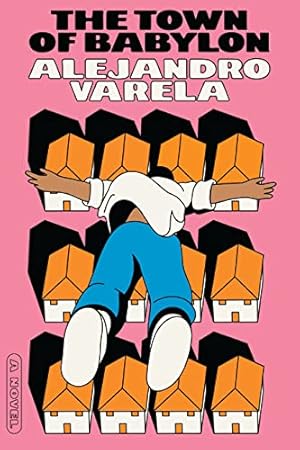
In the Book Notes series, authors create and discuss a music playlist that relates in some way to their recently published book.
Previous contributors include Jesmyn Ward, Lauren Groff, Bret Easton Ellis, Celeste Ng, T.C. Boyle, Dana Spiotta, Amy Bloom, Aimee Bender, Roxane Gay, and many others.
Alejandro Varela's novel The Town of Babylon is a masterfully told debut.
Publishers Weekly wrote of the book:
"A gay Latinx man reckons with his past when he returns home for his 20th high school class reunion in Varela’s dazzling debut...an incandescent bildungsroman."
In his own words, here is Alejandro Varela's Book Notes music playlist for his novel The Town of Babylon:
The Town of Babylon is a book about community. It’s about a man who returns to a community where he feels little connection to the people around him. It’s about a town that began as a homogenous community and never adapted to its changing demographic. It’s about a country whose founding destroyed pre-existing communities, but then refused to incorporate anyone else. It’s about a people who grew sicker because of its lack of community.
Andrés is the protagonist. He’s a professor of public health who lives in the city and returns to the suburbs of his youth to help his mother take care of his sick father. His marriage is in shambles. While there, he decides to attend his high school reunion, where he encounters people he hasn’t seen in twenty years. He reconnects with his first love, now a married father of two; his best friend, who’s in a psychiatric institute; and a classmate who was involved in an assault that killed a gay man when they were in high school and who is now a born-again preacher. During his stay, Andrés also deals with the loss of his older brother who died ten years earlier.
Music doesn’t only serve as a comic foil in the novel, it’s a backdrop and a mood. Pop music in particular is a staple of life in the suburbs, where people spend much of their lives in their cars and listen to only a handful of radio stations—it was once a handful—that play the same selection of songs in a loop. I tried to convey that affection and familiarity with the pop canon by filling the spaces and layering some of the important moments with music.
The first quarter of the book takes place during the reunion, which was easy to inject with music. Initially, the book included lyrics throughout, but we feared not being able to clear the fair use hurdle, and so we removed them all at the eleventh hour. It wasn’t an easy loss to swallow, not least of all because the copyright laws in these cases are illogical and shortsighted. If a protagonist in a novel sings a few lines of a Pearl Jam song, it only benefits Pearl Jam. I have no doubt that Eddie Vedder wouldn’t have minded, but we didn’t want to take the risk of being sued.
In preparation for the writing of the novel, I created a playlist of 150-plus songs from the mid-’90s, which I listened to the entire time I was writing. Below are the twenty that made it into the book or that heavily influenced my writing process.
One small observation: so much pop music is about the pursuit of sex. At best, there’s a subtle misogyny that permeates most songs written and or performed by men, including a few of the ones on this playlist. I don’t excuse it, but not until I was examining the lyrics for this write-up did I realize how pervasive it was.
One more note: I give the songs’ chart successes, i.e., their peaks on the Billboard Hot 100, because in the novel we learn that Andrés used to go to the local record store every Tuesday, when the new music and charts were released.
Ini Kamoze: “Here Comes the Hotstepper”
This strikes me as a reunion song. It’s a dancehall hit from 1994, which is when Andrés would have been in high school. I didn’t remember this song fondly, but in the process of writing the book, I listened to it repeatedly. Its contagious energy eventually wore me down. It was a big hit, interrupting—for only two weeks—Boyz II Men’s reign at number one on the charts. Ini Kamoze, a Jamaican reggae artist, had been making music for more than fifteen years when Hotstepper became a worldwide phenomenon, and certainly the biggest song of his career. In the novel, it lines up nicely with how Andrés felt at the reunion, namely, alone and with a pressure to come across as cool.
Hanson: “MMMBop”
I have never been able to decipher the lyrics to this song while listening to it. I’ve looked them up and read them numerous times, but all I hear is pubescent wailing—the Hanson brothers were 12, 14, and 17, at the time. Although unintelligible, the song is nevertheless catchy and well composed. It, too, went to the top of the Billboard Hot 100, and it was nominated for Record of the Year at the Grammys, where it lost to Shawn Colvin’s “Sunny Came Home.” I inserted “MMMBop” into the reunion scene because I wanted to see how the protagonists would react to a song that we’re conditioned to consider cheesy. Marie, one of Andrés’s ex-classmates, tries to disdain it but immediately finds herself swaying to the music.
Keith Sweat: “Twisted” (featuring Kut Klose and Pretty Russ)
Another mid-’90s song. The uptempo remix is perfect for a well attended, somewhat crowded reunion where there isn’t much room for dancing. It’s a song that’s meant to be swayed to. It plays as Jeremy appears for the first time. Because of Andrés’s anxiety at the reunion, I used music to offset the tension in those scenes. The lyrics of this song were possibly too square on the nose. They are about a man who’s been wronged and is trying to resist falling back into a relationship with the person who’s hurt him. It mirrors (even if exaggerated) what Andrés is feeling. “Twisted” was a comeback hit of sorts. Sweat had had a few mainstream hits a decade earlier, but his subsequent music was mostly played on R&B stations—what even is R&B? It used to refer to Black music, but sometimes I see Bonnie Raitt listed as R&B, same with N*SYNC. Chart fact: “Twisted” made it to number two, stuck behind “Macarena” by Los del Río.
Meat Loaf and Ellen Foley: “Paradise by the Dashboard Light” & Billy Joel: “Only the Good Die Young”
Both epic songs. Both vivid storytelling. Both depict youthful lust. Both forbidden at Catholic school dances. These are canon for East Coast suburbs. And although they were both released in 1977—twenty years before the high school graduation that’s being commemorated in the novel—they remained popular in 1997. In fact, they were part of the local culture where I grew up, the sorts of songs that led to spontaneous singing and celebration. Neither broke into the top 20, but they were signature songs off of career-defining albums for Meat Loaf and Joel, respectively.
2Pac: “Hail Mary” feat. The Outlawz & Prince Ital Joe
Andrés refers to this song while talking about his high school friend Greg, who, like many of the guys he knew in high school, was obsessed with 2Pac. There was something anomalous about a white boy from the suburbs being so enamored by hip hop, but it was common in the Town. It was common in my youth too—according to sales data, it’s common everywhere. Andrés recounts how Greg would meditate on the lyrics, which is also something I remember from my youth. I’ve often wondered if the people who listen to rap and hip hop so zealously also hear the critiques of state oppression, incarceration, and police. In the case of 2Pac, in the ‘90s, I had the sense that 2Pac, and in particular The Don Killuminati: The 7 Day Theory album that was released just weeks after he was killed, was primarily a way to hype themselves up. To smoke a blunt and take a trip. Greg isn’t featured prominently in the book; he serves primarily as a stand-in for the type of boys who were common in the Town. Boys who expressed their angst and their version of masculinity, as well as their thoughtfulness, through music.
In Jeremy’s basement . . .
Andrés reconnects with Jeremy at the reunion and then feels obliged to swing by his house to buy weed. Jeremy’s wife has taken their kids to swimming lessons, which leaves him and Andrés home alone. They smoke, and Andrés gets very high. He plops down on one of the large couches in the basement and gets caught up thinking about pop music.
Aretha Franklin: “The House That Jack Built”
The exposed wood of the basement walls makes Andrés wonder if Jeremy renovated the house himself, which leads to his riffing on the words house and built, until the Franklin song comes to mind. He likes it well enough, even if, as he argues, it’s too short. While writing the book, I learned that “The House That Jack Built” was a cover, originally recorded by Thelma Jones in the same year (1968). Franklin’s version made it to number seven on the Billboard Hot 100. The B-side was “I Say a Little Prayer,” the Bacharach-David song made famous by Dionne Warwick.
Aretha Franklin: “Jump to it” & “Get it Right”
Andrés gets to thinking about Franklin’s entire catalog. He acknowledges the importance of her years at Atlantic Records, but he’s partial to her early ‘80s output. “Get it Right” is the title track of her second consecutive album produced by Luther Vandross. Apparently the lack of commercial success, relative to the previous album, Jump to It, led to a break in their professional collaborations. This is dumbfounding because Get It Right isn’t only a stronger album than Jump To It, “Get it Right” is a stronger single than “Jump to It.” More playful and yet weightier than its predecessor, it straddles disco, R&B, and pop. And while the lyrics are underwhelming, the vocal arrangements and production give the motivational theme an affecting resonance. Must be listened to at higher-than-average volume. Both were number ones on the R&B chart, but peaked at 24 and 61 on the Hot 100.
Aretha Franklin & George Michael: “I Knew You Were Waiting (For Me)”
This is a bop. Number one for one week. One of the best pop duets of the ‘80s. The lyrics (“Mountain was high . . . Valley was low . . .”) suggest this was meant as an homage to the Motown days. The vocal chemistry between Franklin and Michael is the draw. The lo-fi video of them watching each other perform via videos before suddenly appearing together in the same scene is redolent of a theme song montage of a mediocre sitcom, but fun nonetheless. This song wasn’t only the meeting of two superstars, but performers from different eras, and different races. Interracial collaborations weren’t all that common in the ‘80s—or now. There was Paul McCartney’s duets with Stevie Wonder and Michael Jackson, Philip Bailey and Phil Collins, Run D.M.C and Aerosmith, Patti LaBelle and Michael McDonald, and Prince and Sheena Easton, but they were uncommon enough that when they happened, racially confused queer boys from the suburbs took notice.
Mariah Carey and Boyz II Men: “One Sweet Day”
Andrés laments that the Franklin-Michael duet wasn’t number one for longer. He finds this especially egregious in light of the pop song with the longest reign (16 weeks) of the previous fifty years*: “One Sweet Day.” Andrés is careful to pay his respects to Carey, but wishes this wasn’t her most decorated work. I agree. It’s a powerhouse duet between two of the biggest music acts of the day, but it’s so saccharine, I find it impossible not to cringe whenever I hear it. Whether that’s attributable to my own emotional stuntedness is for future researchers to determine. What I can say with certainty is that Carey has many better songs than this one. Bit of trivia: she co-wrote this track as a tribute to David Cole, one half of C+C Music Factory.
*Two songs have since tied (“Despacito” by Luis Fonsi and Daddy Yankee) or surpassed (“Old Town Road” by Lil Nas X, 19 weeks) this record.
Young MC: “Bust A Move”
As Andrés ruminates on the pop canon—still high—he proposes three songs that could better represent the history of pop music than “One Sweet Day,” one of which is “Bust A Move.” It’s infectious and layered, flippant but tight, self-effacing yet full of bravado. It’s not only rap, it’s pop, and a bit of rock. In fact, the baseline comes courtesy of Flea. Guest vocals by Crystal Blake. Play it loudly in a roomful of people and watch everyone mouthing the words. It peaked at number seven, and won Young MC a Grammy.
Pet Shop Boys, Dusty Springfield: “What Have I Done to Deserve This?”
This song was not on my radar as a kid. I only learned of it in my 30s. Damn. It’s a playful, almost sarcastic post-break-up song. Postmodern? Possibly. It barely follows the standard patterns of pop. Just when you think it’s one song, it becomes another. All of them amazing. In what seems like a random occurrence—I’ve found no record that this 1987 hit (#2) was a reference to the film—it shares its title with Pedro Almodóvar's ¿Qué He Hecho Yo Para Merecer Esto? Pet Shop Boys are a dynamic duo, but their collaborations (trios?)—Liza Minelli, Boy George, and especially this one, with the indomitable Dusty Springfield—are underrated. This is their best.
Prince: “Little Red Corvette”
“Pocket full of horses—Trojans, and some of them used.” It’s fitting that this song climaxes multiple times. Prince is talking cars, talking equestrian, and ultimately, talking sex, with the title serving as a metaphor for the woman he’s talking about/to. Rumor has it that whenever he’s saying “baby,” he’s actually saying “Bebe,” referring to Bebe Buell, the model and singer, who’s also Liv Tyler’s mother. Who knows. What is clear is that this is a slow-burn song that suddenly explodes, and is never the same again. As a kid, I knew it was a risque song because of the word Trojan; by that point, I’d heard of that brand of condoms. And although I didn't know what subversive meant, I sensed Prince was winking at us. Sonically, it’s brilliant; lyrically, it’s a bit gimmicky and borderline misogynist—same with Billy Joel, Young MC. It’s an ode to sex, and yet somehow chaste, critical of a woman’s sexuality, which seems to stem from an insecurity about not being able to perform.
Pearl Jam: “Elderly Woman Behind the Counter in a Small Town”
Simone and Andrés sing this to each other in a psychiatric hospital. Simone is a tremendous Pearl Jam fan. During a nostalgic moment she begins to mumble the words before they become clear and coherent. Andrés reciprocates. “Elderly Woman…” is off of Vs, Pearl Jam’s second album. Eddie Vedder has explained that the song is about a woman’s youthful love returning to their town one day and finding her working in a local store. At first she doesn’t recognize him, and when she does, she’s too embarrassed to say hello. In the novel, Simone isn’t embarrassed. In fact, she’s always direct and assured with Andrés, but I found the narrative symmetry between the lyrics and the novel to be enough for the song to make sense. “Elderly Woman…” wasn’t a radio song. Only Pearl Jam fans knew it well. It struck me that Simone and Andrés would.
Guns N’ Roses: “November Rain”
Throughout the book, Paul’s veneration of Guns N’ Roses comes up. He decorated his room in their posters, he wore their T-shirts, and he dressed up as each of the band members for various Halloweens. When he and Andrés meet up again, they share a moment in the storefront church where Paul is the minister. Before accusing him of a 20-year-old murder, Andrés brings up the rock band. In response, Paul picks up a guitar and sings a few bars of “November Rain,” a ubiquitous radio hit in my youth. Its sonic departure from previous Guns N’ Roses output puts it in a category all its own, like a one-hit wonder. It’s catchy—or maybe manipulative?—and it’s not their best work. It made it to number three on the Billboard 100 chart.
The Goo Goo Dolls: “Slide”
I listened to this song on repeat whenever I was writing about Andrés and Jeremy. There was something exceptionally cloying about it. Addictive, too. It was written as if to elicit the emotions that rest along one’s surface—maybe that is the purview of pop. It builds and gallops and finally knocks you down, and you have no choice but to let it take you. I wasn’t only transported emotionally while channeling this song, I also time traveled. “Slide” was a radio mainstay when I was in high school, just as it was for Andrés and Jeremy. Listening to the song helped my writing process. It’s about a forbidden love, and it crescendos with a marriage proposal. It was playing repeatedly in my mind as I wrote the Andrés-Jeremy chapters and developed their storyline. In real life, the Goo Goo Dolls’ notoriety came and went rather quickly. They dominated pop radio with a handful of hits, but they didn’t chart often because several of their singles weren’t for sale—a record company strategy to boost album sales. The chart rules changed during their heyday, but by then, “Slide” had lost steam and managed to reach only number eight.
The Notorious B.I.G.: “Juicy”
Like “Slide,” “Juicy” doesn’t get a mention in the book. But at one point I wrote that Andrés had little in common with his old classmates except the spaces in their frontal lobes reserved for Biggie Smalls and the Goo Goo Dolls. This song is a classic, in part because it borrows from another classic, Mtume’s “Juicy Fruit.” But this is the best kind of sampling: the newer song is bolder, more infectious. The storytelling, too, is on point. Biggie takes the rags-to-riches tale and makes it fresh and inspiring. We’re dancing and we’re celebrating the rise of a poet king. This was just before hip hop and rap dominated the mainstream; “Juicy” didn’t even break the top 20. Should have been number one.
Friday Nights
Rosario (Andrés’s mom) and Patty (a neighbor) used to meet in each others’ homes for drinks on Friday nights. Music was their backdrop. Often, they found themselves in their own thoughts, reminiscing and possibly even lamenting life as it was. In the book, I wrote that they would listen to Donna Summer, the Doors, the Beatles, and the Pointer Sisters.
Donna Summer: “She Works Hard for the Money”
This isn’t Summer’s best, but it was a bop in the early ‘80s, and it was her last good song. I couldn’t imagine Rosario listening to “Love to Love You Baby” or “I Feel Love.” She might have listened to “Last Dance” or the duet with Streisand, but I chose “She Works Hard for the Money” because it had special resonance for me. It reminded me of my own mother commuting to work. It reminded me of the women who wore sneakers on the train and slipped into heels when they got to their offices. Maybe Rosario and Patty also identified with the song. A number three.
The Doors: “Touch Me”
I’ve tried to like the Doors. I’m trying still. But there’s something dark and unappealing about them, which isn’t to say that art can’t be dark or unappealing and still titillating, but not The Doors. “Touch Me,” in my opinion, is their lightest fare, and I still can’t jibe with it. Why then, one must be wondering, have I included music that I dislike? In this case, I am again borrowing from my own mother, who does, in fact, love The Doors. This song, which was (also) a number three, was a compromise between my criticism and my mother’s favs.
The Beatles: “Penny Lane”
Rosario and Patty certainly loved the Beatles, a group that would have peaked in popularity when they were in their teen years. I had no problem imagining the band as the soundtrack through two bottles of wine. I chose “Penny Lane” because it’s deceptively gossamer. But the music is somewhere between rock song and symphony, and that piccolo trumpet solo is almost avant garde. It was one of the Beatles’ 20 number ones. Those cats had so many hits that their B-sides were also hits. In this case, the B-side to “Penny Lane” was “Strawberry Fields Forever.”
The Pointer Sisters: “Dare Me”
I mention the Pointer Sisters often in my work. I don’t know much about them. Maybe they’re right-wingers. Maybe they’re anti-choice and pro-gun. I’m glad I don’t know these things because I’m an unabashed fan. They began as a quartet but found their success as a trio. The height of their fame was in the late ‘70s and early ‘80s, when they had a steady stream of top ten hits. This gem, “Dare Me,” stalled at #11, but it’s as good as any of their other songs. A pop song and a challenge: I dare you to dare me. Plus, it’s replete with an ‘80s synth vibe, daring us all to dance. It’s a mistake to listen to this song at a level of volume beneath blaring. Also, the fact that the Pointer Sisters are not in the Rock and Roll Hall of Fame but Buffalo Springfield is tells us everything we need to know about the lunacy of this earth.
Alejandro Varela (he/him) is based in New York. His work has appeared in The Point magazine, Boston Review, Harper's Magazine, The Rumpus, Joyland Magazine, The Brooklyn Rail, The Offing, Blunderbuss Magazine, Pariahs (an anthology, SFA Press, 2016), the Southampton Review, and The New Republic. He is a 2019 Jerome Fellow in Literature and his graduate studies were in public health.
If you appreciate the work that goes into Largehearted Boy, please consider making a donation.


