

« older | Main Largehearted Boy Page | newer »
January 28, 2020
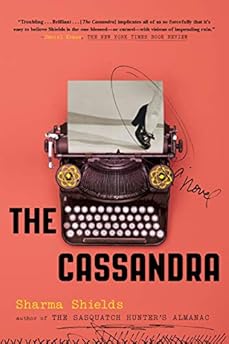
Sharma Shields' Playlist for Her Novel "The Cassandra"
In the Book Notes series, authors create and discuss a music playlist that relates in some way to their recently published book.
Previous contributors include Jesmyn Ward, Lauren Groff, Bret Easton Ellis, Celeste Ng, T.C. Boyle, Dana Spiotta, Amy Bloom, Aimee Bender, Heidi Julavits, Roxane Gay, and many others.
Sharma Shields' novel The Cassandra is powerful, relevant, and masterfully told.
Booklist wrote of the book:
"[A] galvanizing variation on the ancient Greek tale of a seer doomed always to be right, yet never to be believed. Shields . . . offers satirically comedic scenes and satisfyingly venomous takedowns of the patriarchy, welcome flashes of light in this otherwise harrowing dive into the darkest depths of hubris and apocalyptic destruction. A uniquely audacious approach to the nuclear nightmare."
In her own words, here is Sharma Shields' Book Notes music playlist for her novel The Cassandra:
The Cassandra is a historical-fabulist novel set at the Hanford Research Center during World War II, the top-secret site that produced the plutonium for Fat Man, the bomb dropped on Nagasaki.
Hanford’s presence in the Northwest has been a sinister one, both for its role overseas and also for the environmental harm it’s waged locally, polluting water, air, soil, and livestock, and resulting in numerous birth defects, miscarriages, thyroid issues, cancers, autoimmune diseases, paralysis, and more in the Inland Northwest population. Hanford is deemed by the EPA as the most contaminated site in North America, “with 200 miles of polluted sludge, soil, and groundwater.” For years the site operated under a policy of “Never pay, never admit,” keeping the contamination so cloaked in secrecy that those harmed by it were completely unaware of their illness’s origins.
The Cassandra's clairvoyant narrator, Mildred Groves, predicts this menacing legacy, but her warnings go unheeded. The songs I’ve chosen here reflect my narrator’s prophecies, dreams, and nightmares. Mildred, like the Cassandra of Aeschylus’s Agamemnon, is a young woman who is both powerful and powerless, soothsaying and unreliable, gifted with foresight but cursed to never be believed. She is observer, victim, murderess, oracle. The playlist here, similarly, flirts with doom and secrets and power, looming large with female perspective.
“The Toy” by Big Thief
Big Thief has written masterful songs exploring themes of domestic and global violence, both major themes in The Cassandra. Adrianne Lenker’s piquant voice and guitar playing conveys Mildred Groves’s shimmering power and vulnerability. From the beginning of the novel, even when she is star-struck, eager, patriotic to a fault, Mildred vibrates with a sense of doom. She wants Hanford to be her salvation—she believes that her new job will heal the world and bring her, finally, a sense of purpose. As the novel unfolds Mildred’s tenuous grip on this idealism loosens; her visions intensify. When Lenker sings, moaning, pained, “What a tool we’re building here / In the sphere, that’s where we all die…And the croon, distant as paper / children burn, faceless vapor,” it could be Mildred singing of her work at the B Reactor and of the atomic bombs. In Hiroshima and Nagasaki combined, the bombs killed an estimated 220,000 civilians.
“american dream” by LCD Soundsystem
I needed an “American dream” song on this playlist, but it had to be one with a deep sense of irony and darkness. I love the instrumentation on this song, it instantly plunges us into a pensive if maudlin place, and the lyrics belie the uplift of James Murphy’s voice, words that are both funny and awful, about drugs, mortality, loneliness. With The Cassandra, I wanted readers to look more frankly at our nation’s history of violence and secrecy and the ways in which our grievous wrongs against humanity—both interpersonal and global—have harmed others. “Look what happened when you were dreaming / Then punch yourself in the face.” Similarly Mildred engages in an act of violence against herself—it’s what she’s been taught to do (the silencing of women), and also to quiet her own suffering. The American dream, such a beacon of hope for her in the beginning of the book, turns out to be a sham by the book’s end, an ideal applicable to only the very few.
“Dreams” by Solange
Like the speaker in this haunting song, Mildred has dreams from an early age. Her dreams are pictures from the future, usually uninvited, but Mildred delights in their power even as they terrify her. As a girl she ruins friendships by bluntly issuing prophecies, Your mother will die in a car crash; she frequently sleepwalks and awakens to visions while wading, precariously, in the chilly Okanogan River. As Solange says, the dreams “Come undone,” and Mildred, too, feels that she’s “going down, down…dreams and eyes wide (No, no, no).”
“Come into the Water” by Mitski
Much of this novel takes place on the waters of the Columbia, the largest river in the Pacific Northwest. The location was chosen particularly for the Columbia’s muscularity: the project needed a major source of fresh cold water to cool the reaction and forge the plutonium. I spent my childhood in Central Washington, visiting my grandparents in Okanogan, a couple of hours removed from Hanford, and I thought quite a lot of the dramatic basalt walls of the region, the way the light hits the bare hillsides, the pale color of the prodigious sage brush and its sharp, clean scent. When we visited friends in the Tri Cities, I swam in the Columbia, but I was warned not to, because of the pollution there, all due to by Hanford. There was an unpleasant chemical smell to the river, and it hung on me thickly until I showered.
Ironically, the Hanford reach is one of the only undammed portions of the river, even with its poisoned waters. The displaced Wanapum (part of the Yakama Nation) have fought hard since Hanford’s inception for visitation rights to their ancestral fishing grounds, and in 1957 were granted rights to it again by the federal government.
Much like Mitski’s lovely, moody song suggests, the river beckons and speaks to Mildred. It communicates to her in her visions, showing her unimaginable horrors. The novel’s most intense transitions occur along its shore.
“I Want Wind to Blow,” by The Microphones
The winds at Hanford were brutal, deemed “termination winds” because it was a major factor in the high turnover there. Administrators at Hanford tried to keep employees from leaving by bringing top stars—singers, actresses, etc. (blindfolded so as not to disclose the site’s top secret location)—to the site for entertainment. There was beer and food aplenty, despite the rest of the nation being rationed. Only white people were allowed to enjoy the entertainment; the black population was segregated into their own barracks and meeting halls, where no perks were provided. For these reasons and more, Hanford was called by many “The Mississippi of the North.”
Toxic masculinity, like racism, also ran amuck there. A high fence and barbed wire were put up around the women’s barracks for protection after a series of threats and rapes. There were guards with dogs. The impression many people had of Hanford was that it was a wild place, ravaged by wind and rough men.
In Mildred’s visions, the wind has a voice, a woman’s voice, filled with power and consistency. It’s when the wind goes quiet that Mildred is attacked by a man who is predator, a sadist.
This Microphones song starts softly and gathers power steadily, so that you can practically hear wind chimes smacking together by the end of it. Like Mildred, the singer asks for the wind to blow to create passage/change, “My clothes off me / Sweep me off my feet, / Take me up and bring me back.” Mildred speaks to the wind with a similar plea for transformation and dissolution.
“Baby Forgive Me” by Robyn
I even like my dance songs dark, and this is a great one, even if forgiveness is a minor theme in my novel. This is a novel about Knowing Thyself, as the Oracle at Delphi urges. “Baby be brave, be wise,” is, as Robyn sings in her breathy voice, a good place to start as we acknowledge our injurious and even fatal lapses in compassion. In an interview in Pitchfork, Robyn says of this song in particular, “It’s about power dynamics in a relationship. It’s about hurt.”
In one of her final visions in the novel, Mildred witnesses a young Japanese girl undergoing testing at the hands of American doctors, who were sent overseas not to help the injured but to study the effects of the bombs. Mildred’s visions have become so powerful now that she almost melds into the girl, barely able to pull away from the vision and return to her own thrashing body on the banks of the Columbia River. Mildred is able as I am (as writer) to withdraw from a heartbreaking story back into her own world of privilege, however damaged it may be. Forgiveness will only ever be possible if we can rightly atone for our wrongdoings, and it should be secondary to our accepting responsibility and enforcing compassionate change.
At the novel’s end, it could be argued that Mildred and her family accept one another if they haven’t actually forgiven one another, but there’s a sense that a firmer, truer footing has been established.
“No One’s Easy to Love” by Sharon Van Etten
When I speak to book clubs I’m sometimes asked why I make my characters so unlikable, unreliable. In this novel in particular, I wanted to stare our ugly history directly in the eye and write unflinchingly about our greatest grievances against humanity, interpersonally, regionally, globally (all are connected for me). This isn’t just a novel about our country’s wrongdoings, it’s also about our individual wrongdoings, and Mildred is as guilty and complicit in these horrors as I feel I am. I’m hard on myself and I’m hard on my characters. But there is still love here in this book, women coming through for one another, as damaged and battered and hurtful and mistaken as some of those women are. There are good men in these pages, too, but even the well-meaning are hurt in the long run by toxic masculinity and colonial militancy.
As for Mildred’s unreliability, I believe her dishonesty with herself and with the reader runs parallel to the ways in which our country whitewashes its history and wrongdoings, and to the secrecy and duplicity of Hanford, itself. But by the book’s end, Mildred, harmed, wronged and also wrongful, a murderess in more ways than one, sees herself and her country for what they truly are, and there is a grounding power to be found here, a sense of a new starting point where going forward she can uncover truth and not folly. Not everyone will read the ending as happy but I do intend it to be empowering.
“No One’s Easy to Love” as Sharon Van Etten croons in this rock ballad, but I want us to push for that love, anyway, and to stop denying love and care to so many people as we tend to do.
Sharma Shields and The Cassandra links:
Booklist review
Kirkus review
New York Times review
Publishers Weekly review
Tor.com review
Largehearted Boy Book Notes essay by the author for Favorite Monster
Largehearted Boy Book Notes essay by the author for The Sasquatch Hunter's Almanac
Paste profile of the author
Spokane Public Radio interview with the author
also at Largehearted Boy:
Support the Largehearted Boy website
Book Notes (2015 - ) (authors create music playlists for their book)
Book Notes (2012 - 2014) (authors create music playlists for their book)
Book Notes (2005 - 2011) (authors create music playlists for their book)
my 11 favorite Book Notes playlist essays
Antiheroines (interviews with up and coming female comics artists)
Atomic Books Comics Preview (weekly comics highlights)
guest book reviews
Librairie Drawn & Quarterly Books of the Week (recommended new books, magazines, and comics)
musician/author interviews
Note Books (musicians discuss literature)
Short Cuts (writers pair a song with their short story or essay)
Shorties (daily music, literature, and pop culture links)
Soundtracked (composers and directors discuss their film's soundtracks)
weekly music release lists


