

« older | Main Largehearted Boy Page | newer »
May 19, 2020
Carter Sickels' Playlist for His Novel "The Prettiest Star"
In the Book Notes series, authors create and discuss a music playlist that relates in some way to their recently published book.
Previous contributors include Jesmyn Ward, Lauren Groff, Bret Easton Ellis, Celeste Ng, T.C. Boyle, Dana Spiotta, Amy Bloom, Aimee Bender, Roxane Gay, and many others.
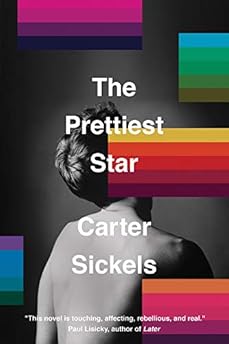
Carter Sickels' novel The Prettiest Star is heartbreakingly beautiful, a book as lyrical as it is unforgettable.
The San Francisco Chronicle wrote of the book:
"Between Brian, Jess and Sharon, Sickels weaves a rewarding but complicated web that creates conflict within all of them. It’s real in the way a video journal might seem real — visceral, confessional and immediate."
In his own words, here is Carter Sickels' Book Notes music playlist for his novel The Prettiest Star:
Mix Tape for The Prettiest Star
The Prettiest Star takes place in 1986, a year after Rock Hudson died of AIDS, and a shifting point in the epidemic that brought the news of AIDS into living rooms and kitchens across America. Most people didn’t want to talk about it. They certainly didn’t want to help, or show any kindness to the gay men who were sick and dying. My novel is about one family in a small, stifling town in Ohio, and their estranged son who comes back home—it’s about a country’s silence and denial, and about the occasional sparks of grace and love.
Music shows up all through The Prettiest Star. It’s the time of MTV, Casey Kasem’s Top 40 Countdown, Walkmans, boom-boxes, cassette tapes, mix tapes. Madonna, Prince, Whitney. And, the endless one-hit wonders. The soundtrack spans the ’70s and ’80s, with David Bowie at the helm. Most of these songs are mentioned in the novel, and they all speak to the time period or the characters. Although I don’t usually listen to music while I’m writing—lyrics get in the way for me—I listened to a lot of Bowie and hits from the ’80s as I was walking around the neighborhood or driving in my car, and the music gave me a way to sink into my characters and their world. I bought old copies of Rolling Stone on eBay and researched the pop charts, and watched a lot of ’80s music videos, which carried me back to my own childhood and adolescence, and provided a little bit of levity (’80s bands took themselves so seriously, belting out ballads with their massive, stiff, fussy hair pointing to the sky). This soundtrack also pays homage to the queer men and divas and gods of rock who died while I was working on this novel—2016 was a rough year.
1. “Changes” by David Bowie
After living in New York City for the past six years, Brian Jackson, a 24-year old gay, HIV+ man, returns to his hometown, the place he’d longed to escape. When he was a teenager, the music of David Bowie proved to him that another way of life existed outside the confines of Chester, Ohio. Electric, glamorous, and free, Bowie is The Prettiest Star’s queer saint, a glorious spectral winding through its pages. This particular song speaks to the way Brian feels like a stranger in his family, and to his family’s struggle—or plain refusal—to understand him. While his parents would prefer not to see the truth, Brian knows he must “Turn and face the strange.”
2. “I Would Die 4 U” by Prince
Brian’s little sister Jess is a savvy, spirited fourteen-year-old who doesn’t understand why her parents are acting so weird around her brother. She’s been waiting for him to come back all these years. When she was a kid, Brian introduced her to disco and Bowie and Queen, and now she’s developed her own taste in music—preferring Janet Jackson, Whitney Houston, Madonna, Prince. I think Prince touches her in a way that Bowie did Brian, shining with strangeness and sexiness and possibility. Prince died I was working on this novel, and I couldn’t stop listening to his music and thinking about how he helped queer the ’80s. This song starts with some of the best lyrics in pop music: “I’m not a woman / I’m not a man / I am something that you'll never understand.”
3. “Oh! You Pretty Things” by David Bowie
This is a weird, brilliant song, and as I was listening to it, I kept thinking of all the young queers whose parents can’t or won’t understand them, and who flock to cities, like Brian did, and find each other and shake free of the shame. “Look out at your children / See their faces in golden rays / Don’t kid yourself they belong to you / They’re the start of a coming race.” We all want to live our lives. We all want to be seen.
4. “9 to 5” by Dolly Parton
Brian would have seen Dolly for the first time on the Porter Wagoner Show, and he and his grandmother, Lettie, both loved her. When he was little, Brian used to imitate Dolly, dancing and singing her hits, including one of his grandmother’s favorites, “Touch Your Woman.” “9 to 5” came out in 1980, the year Brian moved to New York. I like to think that while Lettie was listening to Dolly singing about a cup of ambition as she drove around the county, working hard to sell her Avon products, Brian was also listening to her as he walked around Manhattan—that Dolly’s voice still connected them.
5. “Into the Groove” by Madonna
Can you write a novel that takes place in 1986 and not include the Queen of Pop? Jess listens to her constantly, and Brian saw her perform in New York before she was a mega star. In the ’80s, I owned all of Madonna’s tapes. Jess does too. Despite her controversies, Madonna shimmered as a gay icon, and her catchy pop tunes and her omnipresent fashion, from all those rubber bracelets and crucifixes to platinum hair and black leather, defined the ’80s.
6. “All the Young Dudes” by David Bowie
This song came out in 1974, years before people started dying of AIDS, but as I was working on my novel, the lyrics haunted me. These young men who “carry the news” in their bodies, and yet no one listens, no one cares. The first cases of AIDS were discovered in the U.S. in 1981, and although clearly a public health crisis was developing, the Reagan administration did not act. President Reagan didn’t publicly address the nation about AIDS until 1987, when over 40,000 people in the U.S. had died of AIDS, and the same year the grass-roots activist organization ACT UP (AIDS Coalition to Unleash Power) formed in New York to fight AIDS and government indifference, proclaiming what would become the most iconic and resonate message for queers across the country: Silence equals death.
7. “How Will I Know” Whitney Houston
Oh, Whitney. You also left us too soon. This song is for Andrew, the unapologetic queen working at Sears, who becomes a member of Brian’s chosen family. On this pop-dance track, you can hear the power of Whitney’s astonishing voice, of course, but I also love this song for its simple joy—who doesn’t want to shake hips or shimmy shoulders to this? Despite the grief and loss and pain for so many in the queer community during the ’80s, there was also friendship, love, and joy. Queers know how to take care of each other, how to step in to be the parents and brothers and sisters. A new kind of family.
8. “I’m Your Man” Wham!
This is such a great song but never reached the popularity of Wham!’s hit “Wake Me Up Before You Go-Go” – yes, that’s the title—or George Michael’s later solo work, like the brilliant Faith or haunting Listen Without Prejudice. Yes, okay, like most ’80s pop, the lyrics are a little thin and predictable, but, still, it’s a fun song, and, although George Michael wasn’t out at the time, the song is so gay! I also highly recommend watching the music video, which includes a lot of tambourine shaking. When George Michael died in 2016, the first death of the three kings, it shook me—I’d listened to his music all through the ’80s and into the ’90s. After he was arrested by an undercover cop for soliciting sex in 1998 and mocked by the press, Michaels publicly came out. He spoke about how he’d struggled living a closeted life and losing his lover to AIDS. Until the time of his death, Michaels was an outspoken supporter of LGBTQ rights and funding for HIV/AIDS, and unapologetically queer. His music, videos, and his presence radiated with sex, and, even when he was still closeted, read as deliciously gay.
9. “Upside Down” by Diana Ross
Brian arrived in New York in 1980, the same year that Diana Ross’s gay anthem “I’m Coming Out” and “Upside Down” hit the charts. For Ross, disco wasn’t dead, and the gays loved her for it. Not long after Brian made New York his home, he met Annie, his best friend, and later, Shawn, the love of his life, and they become his family. For so many in the LGBTQ community, the club is a kind of church. This song captures the joy of the dance floor crowded with queer bodies delighting in being alive and feeling loved.
10. “Don’t You (Forget About Me)” by Simple Minds
Everything in the ’80s was big. Big hair, big belts, big jewelry. The Big Gesture. Big Music. Every pop hit wanted to be an anthem. Songs about love and loss were dramatic and earnest and heartfelt and catchy. This sing-along track played constantly on the radio, making all of us wish we were part of a John Hughes’s teen fantasy. It’s a perfect song for 14-year-old Jess. Later in the novel, angry and confused about her brother, she dreams about leaving too, and wants everyone to miss her.
11. “Under Pressure” by Queen and David Bowie
I couldn’t not include Freddie Mercury, who died of complications from AIDS in 1991. Of course Brian listened to a lot of Queen, and the androgyny and queer appeal of Freddie Mercury in his glam rock sparkling sequin suit would have seared into his teenage brain. Brian would have been thrilled when his two heroes released this song together in 1982. “It’s the terror of knowing what the world is about,” they sing. The lyrics resonated for me while I was working on this novel—the pressure Brian feels to keep his sexuality and HIV status a secret, even from his little sister and grandmother, and to carry his parents’ shame, until the pressure culminates in a scene in the last third of the novel, when he makes a choice to be seen: “Can’t we give ourselves one more chance? / Why can’t we give love that one more chance?”
12. “Paths That Cross” by Patti Smith
This is the only song I’ve included that was recorded after the novel takes place (it was released in 1988), but it’s one that I listened to over and over. Smith wrote this song in memory of artist Robert Mapplethorpe’s partner, Samuel J. Wagstaff, who died of pneumonia from AIDS in 1987. The loss of so many artists, writers, actors in such a short span time—impossible to grasp. “We’ll meet again I don't know when / Hold tight bye bye / Paths that cross / Will cross again.”
13. “Starman” by David Bowie
Maybe my favorite Bowie song, and one that Brian listened to gazing out his bedroom window, thinking of dreams places. Extraterrestrial starman, transformation, time travel. Another world for him, waiting.
14. “So Far Away” by Carole King
Part of this novel is from the point of view of Sharon, Brian’s mother, and we see her trying to work through her own fears and prejudices and mistakes. Writer and singer of easy-listening but haunting and sorrowful music, Carole King is Sharon’s favorite singer, and this song, as well as “Home” and “Way Over Yonder” speak to the novel’s questions of family, loss, and home. Lettie, Brian’s grandmother, stands by her beloved grandson, but his parents, including Sharon, are more complicit in their rejections and silences, and even though Brian now lives with them, their inability to fully accept him creates a distance. For too long, Sharon can’t find the courage to break through: “Long ago I reached for you and there you stood / Holding you again could only do me good / Oh how I wish I could but you’re so far away.”
15. “The Prettiest Star” by David Bowie
David Bowie died on January 10, 2016, and left us his legacy—his music and voice and art. The original version of “The Prettiest Star” released in 1970 is sweet and simple, and the more well-known remake, appearing on Aladdin Sane (1972), is amped up and rowdier, more Bowiesque. But both versions are lovely in their own way, and this is a song that Brian used to play for Jess while he dreams about the places he’ll see and the lives he’ll live: “One day, though it might as well be someday/You and I will rise up all the way / All because of what you are / The prettiest star."
Carter Sickels is the author of the novel The Prettiest Star (Hub City Press, 2020) and The Evening Hour (Bloomsbury, 2012), an Oregon Book Award finalist and a Lambda Literary Award finalist. His essays and fiction have appeared or are forthcoming in various publications, including Guernica, Bellevue Literary Review, Green Mountains Review, and BuzzFeed. Carter is the recipient of the 2013 Lambda Literary Emerging Writer Award, and of fellowships from the Bread Loaf Writers’ Conference, the Sewanee Writers’ Conference, the Virginia Center for the Creative Arts, and the MacDowell Colony.
also at Largehearted Boy:
Support the Largehearted Boy website
Book Notes (2018 - ) (authors create music playlists for their book)
Book Notes (2015 - 2017) (authors create music playlists for their book)
Book Notes (2012 - 2014) (authors create music playlists for their book)
Book Notes (2005 - 2011) (authors create music playlists for their book)
my 11 favorite Book Notes playlist essays
Antiheroines (interviews with up and coming female comics artists)
Atomic Books Comics Preview (weekly comics highlights)
Flash Dancers (authors pair original flash fiction with a song
guest book reviews
Librairie Drawn & Quarterly Books of the Week (recommended new books, magazines, and comics)
musician/author interviews
Note Books (musicians discuss literature)
Short Cuts (writers pair a song with their short story or essay)
Shorties (daily music, literature, and pop culture links)
Soundtracked (composers and directors discuss their film's soundtracks)
weekly music release lists


