


« older | Main Largehearted Boy Page | newer »
May 11, 2020
Erika Swyler's Playlist for Her Novel "Light from Other Stars"
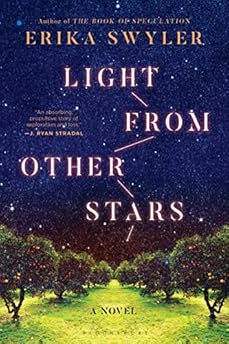
In the Book Notes series, authors create and discuss a music playlist that relates in some way to their recently published book.
Previous contributors include Jesmyn Ward, Lauren Groff, Bret Easton Ellis, Celeste Ng, T.C. Boyle, Dana Spiotta, Amy Bloom, Aimee Bender, Roxane Gay, and many others.
Erika Swyler's literary science fiction novel Light from Other Stars is as ambitious as it is moving.
Publishers Weekly wrote of the book:
"Swyler's beautiful story, told in eloquent prose, induces shivers of wonder. This meditation on time, loss, and the depth of human connection is both melancholy and astonishing."
In her own words, here is Erika Swyler's Book Notes music playlist for her novel Light from Other Stars:
Light from Other Stars, my most recent novel, is literary science fiction that I often refer to as “a small town time-stopping space opera period piece.” One of the main challenges of writing it was balancing the distance and intimacy of deep space and a small town. The music I listened to while writing reflects that dichotomy. Thanks to somewhat creepy data collection and storage, in I can now look at my streaming history and see exactly what I was listening to three and four years ago, the prescription I used for writing a mood. I suppose that’s a kind of distant intimacy with a streaming service. It’s difficult for me to listen to anything that feels current when I’m writing other times. The settings—small-town Florida in 1986, and deep space in the future—had me looking for music that was comforting nostalgia, but also a little eerie. I often loop songs until the lyrics are meaningless and they become something that aligns to feeling more than thought. There were months when I listened to nothing but new wave for its soft fuzziness and retro-future feel, and days when I looped one particular classical piece for hours. Music is as much about time as it is emotion. This is largely the music that wrote Light from Other Stars.
“Major Tom – Coming Home,” Peter Schilling
What an obvious track for a book about space and time. Though I love it, I wasn’t looping Bowie’s Space Oddity, because it’s too forcefully dark. I love that "Major Tom" isn’t a cover—it’s more Schilling’s reaction to art. There’s something about synth that has a cheerful melancholy to it that my ear and brain love. It’s tight and clipped in the verses but the chorus is wide and hopeful. To me, this is the soundtrack of a time travelling astronaut like Nedda going about her day. It sounds like focus and wonder.
“The World Spins Madly On,” The Weepies
The Weepies are the sound of love and close friendships, voices that work better for being with each other. This song in particular is the gentlest recovery from shock, which is what Nedda and Denny are doing on their walk home after witnessing the Challenger disaster. This is a song you play when you need to cry but you’re also a little scared that crying might break you.
“Wouldn’t It Be Nice,” The Beach Boys
When thinking about Denny and his experience of time, I wrote almost exclusively to Pet Sounds. There’s a blooming kind of mania to the album as a whole, even the bubblegum songs like “Wouldn’t It Be Nice.” When you’re feeling trapped and claustrophobic, the things that comfort you most can take a sinister turn. I imagined Denny getting this song stuck in his head because it’s one his mother likes, and what begins as a way of passing time turns sideways. It’s a gorgeous cheery song, but when you take it apart is terrifying. Complicated, beautiful, and totally unhinged.
“Spiegel im Spiegel,” Arvo Pärt
The math of classical and instrumental music tends to work well with the math of my writing thought process. During college I took dance as part of my studies, and much of our work was done to Arvo Pärt’s compositions, so I’m predisposed to equating his work with bodies moving slowly and beautifully in space. “Spiegel im Spiegel” has been used in countless film scores when the viewer’s eye is meant to linger, so I leaned on it pretty heavily when I was trying for a sense of protracted time. When writing about an infant’s experience of life, “Spiegel im Spiegel” got me into the right kind of joyful sadness. I think it’s impossible to listen to this piece without becoming more aware of every second. It’s the lightest heaviest music.
“Only You,” Yaz
Writing a time period in which I was relatively young got me to unearth songs that were playing in the background of my childhood, songs I never owned or knew the names of. There’s such satisfaction when you finally stumble on a song again. Upstairs at Eric’s is a ridiculously good album. Alison Moyet’s earthy vocals against that electronic sound is basically the split that runs through Light from Other Stars. Rediscovering Yaz was rightness clicking into place. “Only You” is the perfect example of this. It’s been playing in my head for ages as this soundtrack of longing. It’s homesickness, it’s heartbreak, it’s nostalgia, but with softness to it. No one dies from this type of longing, but for a time it colors everything about them.
“We Own The Sky,” M83
The whole album Saturdays = Youth sounds like a John Hughes movie with heft. “We Own The Sky” is future-minded but so rooted in 1980s pop that listening to it is a kind of temporal disconnect. This, to me is the soundtrack of forced sleep in the space module, Chawla, as Nedda is dreaming of the past. This is what I imagine looking out a space station window feels and sounds like. The synth has a heavy push to it, but the vocals are mostly breath, and that creates openness and claustrophobia.
“I Need My Girl,” The National
This song digs into the helpless regret of aging men; there’s something in it that works for men who want to make things right—be it for girlfriends, wives, or children. This is Theo looking at his daughter and his wife, it’s Pete thinking about his distant daughter and ex-wife, it’s Desmond thinking about how much he’s screwed up. When I’m trying to pin down what an emotion is because I don’t live in that body, I try to dig into the music of people who do live that way. There was a period in the early 2000s when every aging man I knew told me I had to listen to The National. They were right, but not for the reasons they thought. I got three characters out of that.
“Our Lips Our Sealed,” Fun Boy Three
Everyone in the US knows The Go-Go’s version of this song, and everyone in the UK knows the Fun Boy Three version. I deeply love the sung baseline of Fun Boy Three’s version, which to me makes it feel less produced. Betheen’s world is like this, the discrepancy between interior and exterior. It’s the perfect song for working on hard to solve a problem. It’s darker in sound than The Go-Go’s track, which lends it a kind of double meaning that’s excellent writer fodder. This is the sound of people going through stacks of books, studying, and building small machines. It’s also more than a little angry. It sounds like focused pressure.
“Age of Consent,” New Order
Though Evgeni is deeply Russian in personality and musical taste, there’s a kind of lightness to him that the rhythm and feel of “Age of Consent” encompasses. When I think of characters, they have a background rhythm. The baseline moves through your body in such a way that you can’t help but dance. That’s Evgeni’s function in the crew, to be a motivating heartbeat. And again, there’s a retro-future feel that’s specific to an era, but timeless as well, which is basically the Russian and American space programs.
“(Nothing But) Flowers,” Talking Heads
There was a period in the early 2000s when I was listening almost exclusively to Talking Heads. They creep into my work music a lot and have become background thinking music for me. This is a song for waking up after an apocalypse, and one I think about almost daily. When life changes we start to miss the strangest things—billboards, malls—and that’s lovely.
“3 Gymnopédies: No. 1 Lent et douloureux,” Erik Satie, Jean-Yves Thibaudet
Satie and Pärt are my go-to composers for writing. I love the “Gnossienne” as well, and they’re likely in heavier rotation for me, but the “Gymnopédies” speak to relief from something that’s come before. While the title asks you to think of slow sadness, the piece itself is more like needed rain. No. 1 sounds like continuing, a breath out, and melancholy that’s also hopeful. It’s music to contemplate another time and world to.
Erika Swyler is the author of Light from Other Stars, and the national bestseller The Book of Speculation. Her essays and short fiction have appeared in Literary Hub, Catapult Story, VIDA, The New York Times, and elsewhere. She lives on Long Island, NY, where she writes, bakes, is a casual runner, and has strong feelings about typewriters.
also at Largehearted Boy:
Support the Largehearted Boy website
Book Notes (2018 - ) (authors create music playlists for their book)
Book Notes (2015 - 2017) (authors create music playlists for their book)
Book Notes (2012 - 2014) (authors create music playlists for their book)
Book Notes (2005 - 2011) (authors create music playlists for their book)
my 11 favorite Book Notes playlist essays
Antiheroines (interviews with up and coming female comics artists)
Atomic Books Comics Preview (weekly comics highlights)
Flash Dancers (authors pair original flash fiction with a song
guest book reviews
Librairie Drawn & Quarterly Books of the Week (recommended new books, magazines, and comics)
musician/author interviews
Note Books (musicians discuss literature)
Short Cuts (writers pair a song with their short story or essay)
Shorties (daily music, literature, and pop culture links)
Soundtracked (composers and directors discuss their film's soundtracks)
weekly music release lists


