

« older | Main Largehearted Boy Page | newer »
September 4, 2020
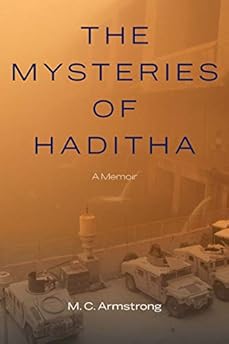
M. C. Armstrong's Playlist for His Memoir "The Mysteries of Haditha"
In the Book Notes series, authors create and discuss a music playlist that relates in some way to their recently published book.
Previous contributors include Jesmyn Ward, Lauren Groff, Bret Easton Ellis, Celeste Ng, T.C. Boyle, Dana Spiotta, Amy Bloom, Aimee Bender, Roxane Gay, and many others.
M. C. Armstrong's The Mysteries of Haditha is more than a war memoir, the book combines reportage with autobiography to remarkable effect.
Phil Klay wrote of the book:
"The Mysteries of Haditha is a unique and fascinating book. . . . This memoir is an account of the complex mixture of motives that led M. C. Armstrong [to Iraq], as well as his attempt to make sense of a war that was rapidly changing around him, and ever obscured by a haze of glamour and horror, masculine posturing, and political machinations."
In his own words, here is M. C. Armstrong's Book Notes music playlist for his memoir The Mysteries of Haditha:
The Mysteries of Haditha is my first book and recalls my time in Iraq as a journalist embedded with Navy SEALS, one of whom was a close friend of mine from high school. Like the Global War on Terror, my story’s borders are both rigorous and deliberately porous. The Mysteries of Haditha swings back and forth between “the homeland” and “the theater of war.” So many war stories confine themselves to war, or war’s most obvious and clichéd moments of blood and guts, death on the battlefield. With an almost priestly fidelity to the death-centered plot and the homoerotic life of the platoon, these stories consecrate war’s culture of violence and erasure, even though they often conclude with token condemnations of that very culture. I wanted to do something different.
I wanted my memoir to play with different genres and the perceptions and experiences those genres afford their writers and readers. This is a love story, a story of a friendship with deep roots, and a mother who made her son promise to tell the truth. This is also the story of a songwriter who found himself briefly performing the role of an investigative journalist. My work as the singer/songwriter for Viva la Muerte shaped my time in Iraq and certainly shaped the journalism, fiction, and poetry I produced after I returned. Are we allowed to discuss national security revelations, white privilege, and rock n’roll in the same breath? Can a song go back and forth between the burn pits, the bedroom, and the classroom? If a song and a war can ignore the old borders, why not a memoir?
“Whirling Birds Ceremony” by Dhaffer Youssef
The journey to Haditha begins in the belly of a blackbird, and so I begin this playlist with Dhafer Youssef’s “Whirling Birds Ceremony.” What I love most about Youssef’s music is his play with space and genre. I’m never quite sure where I’m at—whether I’m in jazz, classical, post-Rock, or a contemporary form of Sufi electronica. If The Mysteries of Haditha is a war of worlds and genres—travelogue, combat zone journalism, and autobiography—then beginning this adventure with the whirling birds of Youseff’s imagination makes sense and I think it will help unsettle the senses of listeners. As all the lights went out in the C-130 Hercules and that winged American warship began its dark spiral descent into Baghdad, I suddenly knew I knew nothing about the country and the war I was flying in to witness. Youseff’s nod to the Sufi—to the mysticism of the Arab world—helps me remember touching down in Iraq, and that great cloud of unknowing.
“War on War” by Wilco
The Global War on Terror was linguistically framed as an unbound assault on fear. Wilco’s “War on War,” which dropped in 2001, the year of the 9/11 attacks, always struck me as the quintessential war on terror anthem, a prophecy of the absurdities and wisdom to come: “You have to lose. You have to learn how to die. If you want to be alive.” I suspect the mystical insight of these lines seeded my band’s name: Viva la Muerte. When I was in Iraq, I kept a journal with me where I scrawled notes for a novel, observations for journalism, and lyrics for Viva la Muerte. That Wilco chant of “it’s a war on war, it’s a war on war, it’s a war on war,” is not just a song that seems appropriate in retrospect. It was a song Joe Goeke and I often sang during the first years of VLM. It was always in my head as I traveled from Baghdad to Haditha.
“Stellar Wind” by Viva la Muerte
Big Brother haunted my journey to Haditha. When the military scanned my eyeballs in Baghdad—when they took my biometrics—I knew I was now in the matrix. “Stellar Wind” was the code name of the NSA’s mass surveillance system that Edward Snowden blew the whistle on back in 2013. As Xavier Graves and I composed this song that same year, I drew my inspiration from my time on the Euphrates beneath the Haditha Dam and from a strange serendipitous fact: When I returned from Haditha, I moved into a house across the street from Snowden’s uncle.
“Killing in the Name” by Rage Against the Machine
As readers will discover in the memoir, this is a song I sang to myself during a moment of rage and frustration with my father. I wanted to see the war for myself and my father did everything in his power to prevent that. In 1993, my brother gave me Rage Against the Machine’s debut album for my sixteenth birthday. Even before I heard that first track, I was thunderstruck by the artwork, that black and white image of immolation from Vietnam, Thich Quang Duc burning alive in protest. At sixteen, I didn’t understand the story of American imperialism and white supremacy. I had never heard the term “regime change war” and I didn’t imagine my generation would one day be responsible for hundreds of thousands of deaths, the destabilization of the Middle East, and the worst refugee crisis in decades. But as I struggled to find my way into the war as a journalist, I became increasingly aware of America’s secret history as well as the real gap between my father’s concept of patriotism and my own. When I scream this song in the book—when I howled it at the American night back in 2007—I was part man and part boy. I was still the sixteen-year old kid whose father violently removed that tape from the family stereo as the f bombs dropped, but I was also now a thirty-year old man who was just starting to read about the details of the Haditha Massacre.
“Mama Tried” by Merle Haggard
The first time I heard this song was at a Grateful Dead show in 1995 at RFK stadium. Like Youssef, the Dead were a mystical and eclectic experience, a strange amalgam of country, rock, jazz, and noise. To hear Haggard for the first time in a cloud of pot smoke and a sea of hippies was usefully disorienting. After all, Haggard was the man, on the “Platoon” soundtrack, who once sang, “We don’t smoke marijuana in Muskogee.” Well, I got high to Merle that June day at RFK and realized, over time, there was more to this man than nationalism and kneejerk hatred for the other. In “Mama Tried” the listener hears the story of a wayward son whose heart breaks as he remembers his mother’s unconditional love. Nothing breaks my heart more—and nothing gives me more heart—than remembering the way my mother loved me and the way she taught me to value the search for the truth. The Mysteries of Haditha, in many ways, is a test of that love and something my mother once said to me when I was in high school: “If you tell the truth, you won’t get in trouble.”
“Fuck the Pain Away” by Peaches
Here seems a good place to quote at length from the book. I came across Peaches for the first time while embedded with SEALS who were searching for Al Qaeda in the Al Jazira Desert of Al Anbar Province, Iraq: “About four hours into the mission, as we approached another NAI (Named Area of Interest), the men in my Humvee got into an argument. Diet’s music was too sad, according to the other soldiers. Diet disagreed but his men had serious opinions about music. This was the soundtrack of their lives, their war. They protested for more punk and metal and so Gene, our driver, plugged in his iPod. Ballads were replaced with power chords and screams, gritty distortion, death metal and hip-hop. We were listening to the vampy voice and the muffled screams of the Canadian electronic feminist, Peaches, “Fuck the Pain Away,” when Diet told everyone to “Shut the fuck up!”
“Dark Star” by The Grateful Dead
The Mysteries of Haditha is a story about a friendship that got tested by war. My memoir recounts embedding with the SEALS who were part of a JSOF unit in Al Anbar Province, but one SEAL, in particular, made my experience the crucible that it was and still is. I cannot tell you his real name, but I call him Diet in the book because that was his nickname in high school, just as mine was Eat Boy. Growing up together, we were a study in contrasts: “Diet was discipline. I was gluttony. Diet was the Navy SEAL. I was the guy still trying to get a rock n’ roll band together and living week to week.” As we grew older, America’s cultural binary threatened to divide us into boring and predictable halves: hippie and soldier; liberal and conservative; poor and rich; single and married; peace and war. But one thing that always helped trouble that binary was music and our memory of music’s mystifying powers. Diet was with me that day at RFK in 1995. We both got to experience the Dead on the verge of adulthood in that time between the fall of the Berlin Wall and the collapse of the Twin Towers. Those nights we spent in Haditha on the banks of the Euphrates almost always came to a close with a good talk, a little tobacco, and the music of the Dead. On at least one night (and perhaps every night), we went to sleep with Diet’s Macbook playing this long and hypnotic version of “Dark Star” from Live Dead.
“Bodies” by Drowning Pool
Erik Edstrom, in his memoir, UnAmerican, calls “Bodies” the defining song of the Global War on Terror. As a soldier, Edstrom experienced the war much differently than I did. “War on War” was the hallmark anthem for me, but I heard “Bodies” on those convoys in Haditha and in Drowning Pool’s gambit of screaming and metal riffs, I remember another band Diet and I listened to as kids: Ice-9. Ice-9 was a Winchester metal group that played at a place called The Band Room. The Band Room was basically a mold-infested warehouse with carpeted walls, a condemned building that was rented out to this band for seventy bucks a month while the owner tried to figure out when and how to demolish the structure. Before that demolition, however, Diet and I and our group of friends spent many a night surrounded by those carpeted walls listening to a band like Drowning Pool. Before our generation’s war, the fear and anger that fueled that war—the screaming, moshing, and chanting that always stood in stark contrast to the music of the Dead—was extremely present. Like “War on War,” “Bodies” dropped in 2001. In the second person POV lyrics, I can hear the echo of my country’s fear and maybe no small portion of my own: “You wanted in, now you’re here/Driven by hate, consumed by fear.”
“This Land is Your Land” by Woodie Guthrie (Performed by Sharon Jones and the Dap-Kings)
The invasion of Iraq and the Global War on Terror triggered a refugee crisis that has unsettled the entire world. The destabilization of Iraq led to Iraqi refugees flooding Syria and Syria’s subsequent civil war set off an exodus that Europe, Africa, and the United States continues to contend with to this day. As I detail in my book, Diet didn’t want me to tell this story. At one point, I myself wanted to give up on The Mysteries of Haditha. But my country’s shit show has got to stop. Our regime change wars have not made the world a safer place, but as Diet says in the book, “We gotta clean up the mess.” America has made a mess of the world, and it is, therefore, our job to clean up the mess and that means accepting our fair share of responsibility for the refugees of the Global War on Terror, or what some have recently taken to calling The Forever War. So, when Diet tells me in the book that he wants me to sing more funny songs like Arlo Guthrie’s “The Motorcycle Song,” I write that I hear him and that I do sometimes feel afraid that I’m losing my sense of humor. But still, I have to say it: I prefer the songs of Arlo’s father, Woodie, and this one in particular. And this cover by Sharon Jones and the Dap-Kings, even more particularly. For just as Woodie begs us to make space for “you and me” in his song, this cover of Guthrie makes space for a woman of color to share in the property of these beautiful lyrics and this beautiful country. America doesn’t assassinate white people with drones. We have no white prisoners at Guantanamo Bay. The systemic racism we see in our national policing is a reflection of the systemic racism in our international policing. The knee we keep on the neck of Iraq is not so different from the knee we keep on the neck of countless black lives like George Floyd’s. We need to start making more room for America’s oppressed in our songs, our schools, our corporations, our government, and our neighborhoods. “This Land is Your Land,” written by Guthrie but sung with such verve and swing by Jones, testifies to America’s most generous spirt—her better angel.
“Marching the Hate Machines into the Sun” by Thievery Corporation (with The Flaming Lips)
A Global War on Terror playlist would be incomplete without this cosmic cri de coeur. Like Youseff and The Dead, Thievery Corporation presents the world with an eclectic spatial imaginary where genre subversion is the name of the game. Borders are porous in the Thievery experience, and so the tasty shapes of jazz, psychedelic, hip-hop, new wave, and club all come together here, which is what I’d like to see outside of the song. If we can have a war without borders, why not a peace? “Marching the Hate Machines into the Sun” teases the listener with the logic of war: “Let’s start by making it clear who is the enemy here.” Locating an enemy—a boogieman—seems fundamental to war’s foreplay. We need a clear devil. We need a Saddam Hussein and we need to characterize him as Hitler and we need to claim that he’s about to use those nukes that only America has ever used on another country, but we can’t admit to our part, because that complicates the essence of the enemy as other. There’s an important national security revelation toward the end of my memoir. What should I say here about the WMDs of Haditha? What should I say about the corporations that steal our tax dollars to build these bombs? I guess I’d like to say what Thievery Corporation says. Let’s stop. Let’s march the hate machines into the sun.
“11:11” by Viva la Muerte
Song eleven on this post-9/11 playlist goes to the worm of discrepancy on my band’s first album: “11:11.” I wrote this song in Haditha while camped on the banks of the Euphrates. “11:11’s” controversial closing lyric (“I wanna see some violence”) began to trouble me after one of our fans told me it troubled him. Don’t I believe in peace? Why would I platform a voice that’s hungry for violence? Why do video games provide children with first person POV shooters? Like MC Hammer who commits to one Christian song on every album, I commit to one song that draws deep from the darkness. I may have been inspired by The Grateful Dead, but I was also inspired by Ice-9, Jane’s Addiction, Rage Against the Machine, Metallica, and Nirvana. I never liked the binary pressure of having to choose between the hippie and the punk, the spin and the mosh. I always wanted both and so I wanted to write a song that gave the listener both. “11:11” is a song that’s a hybrid of my experience and that of a soldier I met in Haditha. The lonely intro, with its martial cadence, tells the story of a desire for magic and transformation in the wake of a breakup. “11:11 and I wish for you, I don’t believe in magic, but I do,” captures a spirit at war with itself and the temptation to latch onto magical thinking—the belief that the answer is over there. The second half of the song goes over there and travels fast on a plane with a man who wants to “see the plan in the sand.” He wants to see his “fears disappear.” He wants to “see some people disappear.” I met a SEAL in Iraq who told me, while playing a first person POV shooter video game, that his core complaint about the war was that he “wasn’t getting enough kills.” That hunger for violence and “kills” is not just the property of dark savages abroad. It’s in all of us and will remain a powerful force in all of us—the seed of war—until we evolve beyond our need for an enemy.
M. C. Armstrong was embedded with Joint Special Operation Forces in Al Anbar Province, Iraq. He published extensively on the Iraq War through the Winchester (VA) Star and is the winner of a Pushcart Prize. His fiction and nonfiction have appeared in Esquire, Missouri Review, Gettysburg Review, Mayday, Wrath Bearing Tree, Monkeybicycle, Epiphany, Literary Review, and other journals and anthologies. He lives in Greensboro, North Carolina.
If you appreciate the work that goes into Largehearted Boy, please consider making a donation.


