

« older | Main Largehearted Boy Page | newer »
April 12, 2021
Sara Davis's Playlist for Her Novel "The Scapegoat"
In the Book Notes series, authors create and discuss a music playlist that relates in some way to their recently published book.
Previous contributors include Jesmyn Ward, Lauren Groff, Bret Easton Ellis, Celeste Ng, T.C. Boyle, Dana Spiotta, Amy Bloom, Aimee Bender, Roxane Gay, and many others.
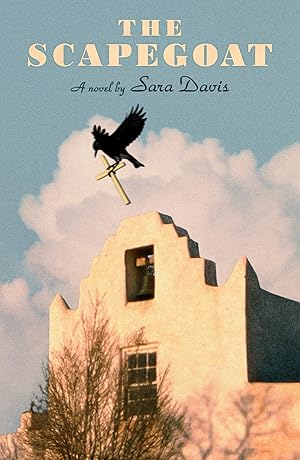
Sara Davis's novel The Scapegoat is an auspicious debut, a brilliant and inventively written book.
The New York Times Book Review wrote of the book:
"As our narrator loses his grip on reality, Davis drops her readers into successive scenes so fluidly that even we forget what just happened. I raced through the book, marveling at its precise, restrained prose and grasping paranoiacally at small details that might indicate what was real and what wasn’t. What does become clear by the end, though, are the dangers of dwelling on past miseries, which so thoroughly haunt the novel."
In her words, here is Sara Davis's Book Notes music playlist for her debut novel The Scapegoat:
When I was growing up my parents worked in a building adjacent to Stanford Hospital. In lieu of afterschool childcare they would pick me up and bring me there to do my homework, eat snacks, and wander around aimlessly. I often went next door to the hospital, which had a cafeteria with pizza, better vending machines, and a gift shop that sold candy. However, the other thing that the hospital had was a lot of visibly sick people, inpatients who walked around in cotton gowns, dragging oxygen tanks behind them. I have an extremely vivid memory of sitting in the cafeteria eating French fries and being mesmerized by a man sitting nearby with a goose-egg-sized growth protruding from his neck.
The other thing about the hospital was that it put on entertainment for the long-term patients; there was a little stage and seating where different performers would come and do shows, a magician, opera singers, puppeteers. Of course, the audience at the shows was again, mostly sick people; some asleep, some merely listless, some justifiably in bad moods.
In my novel, The Scapegoat, the narrator, N, works adjacent to a hospital as well. He sees a flyer for a lunchtime concert of The Kindertotenlieder, a song cycle composed by Gustav Mahler in 1907. He, N, would like so much to be the kind of person who goes to classical music concerts that he decides to go, although when he actually gets to the concert it’s a disappointment; he’s bored and can’t focus.
I moved to Detroit from New York City when I was twenty-six and I was surprised to find that the level of competitive cultural awareness I was used to did not seem as prevalent there, or at least among the people I was meeting. I went to a dinner party where someone explained to the whole table what the Criterion Collection was; I tried to explain to someone that the upcoming Harmony Korine movie Spring Breakers was not a feature-length Girls Gone Wild, but rather something more complicated and artistic.
“What other movies has she directed?” asked the friend skeptically (as you may or may not know, Harmony Korine is a man).
Late into my first year in Michigan I started telling people that I was considering flying back to New York to see the Balthus exhibit at The Metropolitan Museum of Art. In retrospect, I don’t know why I thought it made sense to tell people that, it was such a bizarre thing to say and to consider doing. No one I told had ever heard of Balthus, a French artist of the 20th century known for his erotically charged paintings of pre-pubescent girls, and it did not make any financial sense for a part-time teacher of creative writing to fly anywhere to look at art. I’m sure everyone thought I was really annoying. I did end up going to New York at some point later for the much more reasonable purpose of attending my thesis meeting and the Balthus show was still up. Of course, once there, I felt the same way I do at every art exhibit I have ever been to—fleetingly excited to see the one or two works I’m familiar with, then bored, then wanting to sit down, then wondering when it would be appropriate to go. I’m sure I bought a poster.
This is the feeling I have tried to capture for N. Without further ado: the track listing!
Kindertotenlieder: Nun will die Sonn’ so hell aufgeh’n – Live
Gustav Mahler, Thomas Hampson, Wiener Philharmoniker, Leonard Bernstein
This is the first song in The Kindertotenlieder (Songs on the Death of Children). The lieder, a genre of music that interested me while I was writing the novel, were usually written for just one voice and a piano, meant to be performed in homes rather than in concert halls. This is the version N attends in the hospital. More recently people have been arranging the lieder for a voice and an orchestra, which is what this recording is. It begins with an extremely mournful oboe, includes a glockenspiel, and is sung by American baritone and music scholar Thomas Hampson.
Erlkönig, D.328 (Op.1)
Franz Schubert, Jessye Norman, Phillip Moll
This is probably the most famous example of the lieder of the Romantic era and probably also the one with the best plot. A father is riding through the night with his son, when the Erlkönig (Elf-king) appears (only the boy can see him, not the father). The Erlkönig lures the boy with promises of golden garments and the attentions of his daughters. When the father and child arrive at their destination the boy is dead. This version is sung by the very amazing late American soprano, Jessye Norman.
Piano Sonata in B Minor, Op. 5, TrV 103: II Adagio Cantabile
Richard Strauss, Glenn Gould
About a year into writing the book I came across this quote from the late Canadian pianist Glenn Gould’s journals, which he wrote about a problem he was having with his fingers. “During the next two weeks problems increased,” he wrote. “It was no longer possible to play even Bach Chorale securely — parts were unbalanced, progression from note to note insecure.” It’s hard to explain the feeling I had when I read this, as though my main character could have written these sentences himself (not that he plays piano; he does not, but the voice was so much like his: persnickety, hyper-vigilant, with a growing sense that it’s all somehow unraveling). I printed the line out and put it on my bulletin board and used it as guide if I ever felt like I was getting too far from the voice I wanted. Glenn Gould was also, of course, an interesting character: neurotic, reclusive and famously hypochondriacal.
Close My Eyes
Arthur Russell
I listened to the Arthur Russell album Love Is Overtaking Me a lot during the period of time in which I was writing this book. At that point I felt a lot of personal identification with him as he was notorious for leaving songs unfinished and continually revising his music (and had very little professional success before his untimely death at the age of 40). What can I say, my outlook was cheerful!
Landslide
Fleetwood Mac
My novel is set in Palo Alto, California and its environs, a place where Stevie Nicks and Lindsey Buckingham met in high school. Landslide is not a deep cut but it’s such an undeniably beautiful ballad. To me the line, “Can I handle the seasons of my life?” is an apex for songwriting.
Dire Wolf – 2013 Remaster
Grateful Dead
Incredibly, the Grateful Dead was also founded in Palo Alto (I’m so happy to have this opportunity to share Palo Alto’s impressive musical history with you.) This is one of my favorite Dead songs, apparently written after Jerry Garcia and Robert Hunter watched a movie version of The Hound of the Baskervilles. I like the part when Jerry calls the dire wolf “six hundred pounds of sin.”
Hard Candy Christmas
Dolly Parton
This song is another one I listened to obsessively during the writing-the-book years. In it, Dolly insists that she’ll be “just fine and dandy” but also admits that she’s “barely getting through tomorrow.” If a soundtrack for my book could just include all my favorite songs, this could accompany my narrator in one of his more light-hearted moments, like when he decides to abandon his investigation and make spaghetti in Chapter 11.
Mozart: Die Zauberflöte, K. 620, Act 1 Scene 6: No. 4, Rezitativ und Arie, "O zittre nicht, mein lieber Sohn!" (Königin der Nacht)
Diana Damrau, Jérémie Rhorer, Le Cercle De L'Harmonie
In the novel N is reading a police procedural, and there is a line that reads “it seems that every detective novel I read now features this policeman, whose nationality varies, but who is dependably bitter and divorced, opera his soul’s only worldly solace.” In the book-within-a-book I have the detective listen to Aida, an opera I have not personally ever really listened to. My favorite is The Magic Flute by Mozart, which is notably also the opera that Toru Okada is listening to at the beginning of The Wind-up Bird Chronicle by Murakami, when he makes spaghetti. I studied that book a lot when I was writing my own book. In this aria, the Queen of the Night is trying to convince the hero to go on a quest for her kidnapped daughter. The Queen is clearly scary and a bit unbalanced, which is why she has to tell him at the beginning “O zittre nicht, mein lieber Sohn” (Tremble not, my dear son). Things really get wild around 3:05. There are many versions of this aria on YouTube, with many different sopranos and stagings, like this creepy all-white Louis XIV version or this one, where the Queen rises out of the waves as a blue, armless, fabric mountain. This recording is performed by German soprano Diana Damrau, who is famous for her Queen of the Night, a role that Mozart originally wrote for his sister-in-law for the opera’s premiere in 1791.
Sara Davis, the daughter of two Stanford immunologists, grew up in Palo Alto, California and received her BA and MFA at Columbia University. She has taught creative writing in New York City and Detroit. She has been awarded residencies from Ucross, Vermont Studio Center, and Ragdale. She lives in Shanghai, China. The Scapegoat is her first book.
If you appreciate the work that goes into Largehearted Boy, please consider making a donation.


