

« older | Main Largehearted Boy Page | newer »
January 20, 2022
Manon Steffan Ros's Playlist for Her Novel "The Blue Book of Nebo"
In the Book Notes series, authors create and discuss a music playlist that relates in some way to their recently published book.
Previous contributors include Jesmyn Ward, Lauren Groff, Bret Easton Ellis, Celeste Ng, T.C. Boyle, Dana Spiotta, Amy Bloom, Aimee Bender, Roxane Gay, and many others.
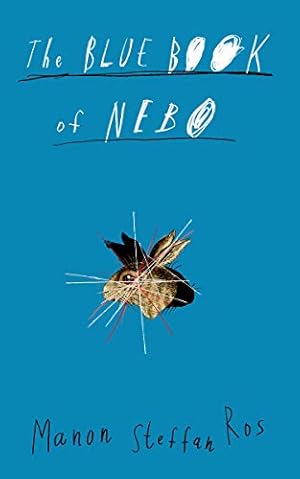
Manon Steffan Ros's novel The Blue Book of Nebo intimately examines a post-apocalyptic world through the lens of the relationship between a mother and child.
Publishers Weekly wrote of the book:
"[A] spare and intimate story of a family surviving a near-future global apocalypse...In a time rife with and ripe for stories of the end, this one stands out."
In her own words, here is Manon Steffan Ros's Book Notes music playlist for her novel The Blue Book of Nebo:
I'm going to be honest. Putting this playlist together took about five times longer than it did to actually write my novel, The Blue Book of Nebo. About ten times longer than it did to translate it from the original Welsh into English. Perhaps part of that is tied to the fact that the novel is set in a post-nuclear landscape with only a mother and son--it is set, therefore, in a mostly musicless world. Silence hangs heavy.
Perhaps I am also affected by the fact that during lockdown, I shut myself off from music. I stopped listening completely for about nine months. I think there's something about music that accesses a vulnerable, tender, emotional space, and I didn't want to go there during lockdown. As social distancing restrictions slowly lifted, my aversion to music slowly abated too, but I found that my tastes had changed. I used to listen to catchy, acerbic pop and stripped-back folk and country; now I barely listen to anything that includes lyrics at all.
The Blue Book of Nebo is a short, tragic and hopeful novel about the increasingly stifling relationship between a mother and her son. The fact that it's set in a dystopia isn't the main theme for me--it's about the characters trying to cope with all they've lost and all they've gained. As I always do when I'm writing, I listened to soundscapes and film scores while writing this book, matching the mood of the music to what I'm trying to create.
De Ushuaia a la Quiaca by Gustavo Santaolalla
I was seventeen and pretending to be ill because I couldn't be bothered to go to school. BBC Radio Three, a classical radio station, was playing, and I was barely listening. Full of a bad lunch and heavy-headed from an overdose of History homework, I was sleepy. As I drifted off, this song came on the radio, and it had an ethereal, magical quality, somehow lulling me so tenderly into sleep. I spent years after that yearning for that song, not knowing the title or artist, not even knowing if I'd dreamt it. One day, over a decade later, it drifted back into my life, light as a radio wave. I was around the same age as Dylan, one of the main characters of The Blue Book of Nebo, when I first heard that song, and there's something about having lived with the fleeting memory of something that felt so transient that has fed into the creation of the novel.
dlp 1.1 (The Disintegration Loops) by William Basinski
The Blue Book of Nebo is, in many ways, a novel about layers of disintegration- after a nuclear disaster, society crumbles, as do the small rituals and habits which prop up our lives. Basinski's Disintegration Loops consist of tape loops which gradually disintegrate as they pass the tape head over and over again. It is such good music to write to, and the small changes and peeling off of layers is so subtle.
Y Gwanwyn by Hogia'r Wyddfa
Hogia'r Wyddfa are something of a Welsh institution, and were the poster boys for a particular kind of Welsh language band that was incredibly popular in the '70s, '80s and '90s- all-male or all-female bands that specialised in catchy tunes and perfect harmonies, who would tour pubs, clubs and village halls throughout Wales. So many of Hogia'r Wyddfa's songs are about their locality, and I think that something that is so deeply rooted in the land carries the weight of mountains and lakes and the histories of all who have been there. It's a song about longing for spring- How difficult it is to mend oneself when there is snow on the mountains. Catchy songs can deceive you into thinking they can't be profound, but this isn't the case with the music of Hogia'r Wyddfa.
22 Onnen by R. Seiliog
After its publication in Welsh in 2018, The Blue Book of Nebo was adapted into a stage play which toured in early 2020. The theatre company asked me if I had in mind any musicians to create a score, and I crossed my fingers and suggested R. Seiliog, a Welsh sonic artist whose music has a tender, instinctual, subtle power. He created a score that was so sensitive and understanding of all that is within The Blue Book of Nebo, the story I'd created, but also the things I'd left unsaid, the things I thought I'd hidden well in the gaps between the words. I will never forget the relief and joy of hearing it, and feeling, Ah! He gets it! R. Seiliog's sound is unlike anything else. Music often tries to emulate the experiences of life, but his work sounds as if it is itself living, breathing, moving and growing. It is alive, and when you listen to it, it becomes part of you in a way nothing else quite does.
Jesus' Blood Never Failed Me Yet by Gavin Bryers
Oh God, this song. A friend introduced me to it a few years ago and it made me weep glittering, silent tears. Bryers' created this track from a fuzzy field recording of a homeless man singing on the street. Bryers' has looped the recording, gradually adding instruments until it becomes something majestic and almost ritualistic in sound. There is faith and hope and love in it, all informed by the story behind the recording. That feeling--hope beyond hope--is something that I hope can sometimes be found in The Blue Book of Nebo.
A Heart Can Be a Ghost by Orbitalpatterns
I only recently happened to stumble upon a reference to this album, These Haunted Objects by Orbitalpatterns, on a subreddit, and have spent the last few months obsessively listening to it whilst walking the paths around my home as summer has paled into autumn around me. I've found myself taking the long way back so that I can listen just one more time. It reminds me of the invisible line drawn between dystopia and utopia in The Blue Book of Nebo. The swell of sound is so satisfying and weaves thoughts so easily, but there's also a painful longing to these songs.
Cymun by Siân James
My first language is Welsh. It's the language my parents spoke to me, and it's the language I speak with my children. There's a lively and varied Welsh language cultural scene, and a great deal of brilliant music. There is such quiet peace in this song, an understated sort of contentment. Siân James has been creating worlds with her music for years, and there's something in the poetry of the words and the soft, lulling quality of her voice that pierces my heart. The title of this song, Cymun, means communion, and there's deep, spiritual, simple joy in the way she describes finding peace in a place and time.
Enough To Be On Your Way by James Taylor
My fourteenth birthday, and my mother bought us both tickets to go and see James Taylor in concert in London. It was the only trip we ever took together, alone, and the memory I have of it is in technicolour. When James Taylor played this song, I reached for her hand. I remember very clearly the way her fingers felt under mine. I am very, very lucky to be her daughter.
James Taylor was an artist I inherited from my parents. I can't remember a time when he wasn't creating a soundtrack to our lives. Those kinds of emotional connections to music and art and books is a theme in The Blue Book of Nebo, but the words of the song also seem apt- It's enough to be on your way / It's enough to cover ground / It's enough to be moving on. I don't listen to it very often because it's too raw, but it's sacred to me.
On The Nature Of Daylight by Max Richter
There is a much overused Welsh word that has its own catalogue of twee memes and facebook posts- it's hiraeth, and is partly admired for the fact that it's untranslatable. Broadly, it describes a longing, for a person or place or object or idea or time, and sometimes just the non-specific, inexplicable sorrow in longing for something you don't quite know what it is. The Blue Book of Nebo carries a lot of hiraeth, I think, both for the pre-apocalyptic world and also for an indescribable future. For me, this song is what hiraeth sounds like. It aches beautifully. (It's just coincidence that this is a track off an album called The Blue Notebooks...)
The Moon Shines Bright by Sam Lee
I rarely listen to music with lyrics anymore- I want the freedom to find my own words and meaning within a musical landscape. But I will always, always make an exception for Sam Lee, whose voice is an instrument of power and gentleness and passion and tenderness. He sings a lot of traditional English folk songs, and it never feels twee or nostalgic- just a natural continuation of the journey of a song. In that way, I think it echoes the way the characters in The Blue Book of Nebo lightly and naturally carry Welsh culture through the books they read. Also, there's a lyric in this song that refers to "the mothering of the soul" that reminds me of the book.
Life by Ludovico Einaudi
There is a lot of the delightful, aching, tugging complexities of parenthood in The Blue Book of Nebo; It's a theme I keep returning to. The fascinating and painful fact that our main job as parents are to prepare our treasured, admired, fiercely adored offspring to be independent of us. We must push that which we love most away. It was around my thirtieth birthday that I decided, for the first time ever, to go to a concert on my own, to take a trip that was just for me. I sat in the audience watching Einaudi perform his album, In a Time Lapse, with an orchestra, and felt such joy at the sway of music and such longing for my kids (who were only a bus ride away) and a loving resignation that life finds its own way. This song always takes me there, to that seat in St David's Hall in Cardiff, and it always reminds me to honour the privilege of parenthood.
The Dead Flag Blues by Godspeed You! Black Emperor
This song, perhaps more than any other, is the one that best describes the theme and mood of The Blue Book of Nebo. It features words from an unfinished screenplay, and is just dripping with decay and disillusionment, corruption and hurt. I must admit that I'd never listened to this album, but when I mentioned to a friend that I was creating this playlist based on The Blue Book of Nebo, he sent me this track. As a result, I've just booked a ticket to see Godspeed You! Black Emperor as an early birthday gift for myself, having complete faith that music will have that same resonance as it did when I was 14 in a James Taylor concert, or when I was 30 watching Einaudi.
Manon Steffan Ros was born in Rhiwlas, Snowdonia. After leaving school, she worked as an actress for a few years before becoming a writer.
Her first novel for adults Fel Aderyn, reached the shortlist for Wales Book of the Year and her novel Blasu won the Fiction Prize of the 2013 Wales Book of the Year. Ros translated Blasu into English with the title The Seasoning and was published by Honno in 2015.
As well as her books for adults, Ros has found great acclaim in her children’s writing. She has won the prestigious Tir Na N-Og prize for Welsh children’s literature four times, with her novels Trwy’r Tonnau (2010), Prism (2012), Pluen (2017) and most recently Fi a Joe Allen (2019).
The Blue Book of Nebo won the Prose Medal at the 2018 Eisteddfod and won the triple crown of prizes at the 2019 Wales Book of the Year Award: the Aberystwyth University Fiction Award, the Golwg360 Barn y Bobl (People's Choice Award) and the Welsh-language Overall Winner.
She has won the drama prize at the Eisteddfod twice in 2005 and 2006, and her play, “Mwgsi,” won a National Theatre Wales award in 2018. She lives in Tywyn, Meirionnydd with her sons.
If you appreciate the work that goes into Largehearted Boy, please consider making a donation.


