

« older | Main Largehearted Boy Page | newer »
April 26, 2021
J. Robert Lennon's Playlist for His Books "Subdivision" and "Let Me Think"
In the Book Notes series, authors create and discuss a music playlist that relates in some way to their recently published book.
Previous contributors include Jesmyn Ward, Lauren Groff, Bret Easton Ellis, Celeste Ng, T.C. Boyle, Dana Spiotta, Amy Bloom, Aimee Bender, Roxane Gay, and many others.
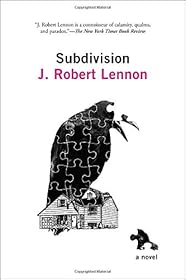
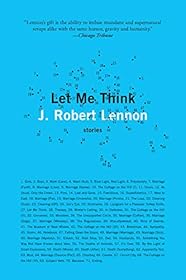
J. Robert Lennon's new novel Subdivision and story collection Let Me Think combine his trademark inventiveness and intelligence with the fierce, unexpected humor he has become known for.
Kirkus wrote of Subdivision:
"An askew, uncanny―and consistently compelling―novel about memory, dislocation, and trauma. . . . [Lennon’s] tone is surreal and the result sometimes, à la Kafka, darkly funny. The novel features elements of the picaresque . . . , but it also has the everyday-suburban-made-strange-and-luminous quality of Steven Millhauser and the gleefully absurd, improvised feel of César Aira. . . . Sharp, inventive―and disorienting in all the good ways."
Publishers Weekly wrote of Let Me Think:
"Lennon (Pieces for the Left Hand) deploys his trademark off-kilter, acrimonious humor in this arresting collection. . . . Lennon has talent to spare."
In his words, here is J. Robert Lennon's Book Notes music playlist for his novel Subdivision and story collection Let Me Think:
My new novel, and much of my new story collection, depart more from representational reality than anything I’ve published before. The logic of these books is drawn from dreams, fugue states, and various kinds of neuroatypical conditions and cognitive impairments. I’ve been preoccupied with death and what the journey to it does to our minds.
In my last playlist on this site, I wrote about the difficulty I find writing in the presence of music or any other kind of organized sound. Since then, however, I got a pair of noise-cancelling headphones, and discovered the white-noise phone app myNoise. This app divides its many available sounds—rain, the ocean, a forest walk, various drones and hums—into ten frequency brands, enabling the user to tune out specific kinds of noise in their environment. I’ve tried them all, but keep returning to a rain present I made that’s heavy on the thunder. Much of these two books was written in busy coffee shops, where sometimes I used myNoise to drown out the human noise that drowned out an actual rainstorm outside. I like the idea of a complex sound designed to be unlistened to.
It’s always sunny and mild in the titual neighborhood of Subdivision, but its cheery exterior masks a deep strangeness that the book’s unnamed protagonist must attempt to understand. A song that has a similar effect is “Funfair,” by Japanese multi-instrumentalist Shugo Tokumaru. Its upbeat, celebratory tones sound like something you might hear off in the distance from the window of a medieval castle, but processed through the kind of hiss and warble an old tape machine might impart. And its strange stereo panning gives the music an otherworldly feel through headphones.
The narrator of Subdivision can’t recall her past, and the world of the novel reflects broken memories of normal life. She keeps getting simple things wrong: the lyrics to “Happy Birthday,” the name of an office toy, the different varieties of batteries available at the drugstore. A similar warping of memory can be heard on The Caretaker’s 2010 album An empty bliss beyond this World, which loops and reprocesses nostalgic music of the past. Its title track is a good example; in it, piano and voice are distorted beyond recognition.
Another form of sonic distortion that has fascinated me lately is the world of OpenAI Jukebox, a software neural net that can generate new music based on its analysis of existing music. I don’t think I’ve found anything on YouTube more disturbing than this AI-generated fake Beach Boys album which at times sounds uncannily like the beloved California crooners and at times like a brain aneurysm. In the novel, I actually used a publicly available Markov-chain text generator to create a few pages of pastiche fiction for Cylvia, the book’s digital assistant, to recite.
A more sophisticated use of AI composition and sound generation can be found in the music of Holly Herndon, like this track “Crawler” from her album Proto. Herndon and her ensemble of vocal artists create recordings and performances in collaboration with an AI called Spawn, designed by Herndon and programmer Jules LaPlace. The musicians share musical ideas with the software and incorporate its responses back into the pieces. Here’s an interview with Herndon about the process in TapeOp Magazine. (Free account required to read the whole thing)
Customizing music-making machines has a long history that predates the era of computers; the prepared piano, for example, has been used in compositions as divergent in period and style as those of John Cage (“Bacchanale,” 1938, and subsequent sonatas) and Aphex Twin (Drukqs, 2001). Terry Riley altered a Yamaha YC-45D transistor organ so that it could play in just intonation, and used it, along with a delay effect, to create his 1980 album Shri Camel. Here’s a version of the composition performed live in 1977.
Let Me Think is full of experiments and limiting exercises. It originally contained a few dozen prose poems created by mistranslating foreign-language texts and using academic faculty meetings as collage material, but I took those out and published them separately as Mistranslations and Meeting Notes in 2019.Among the extant experimental stories are ones composed entirely in the text message app on my phone, and sent, immediately upon completion, to a random person on my contact list. This Kendrick Lamar track, “PRIDE.,” was produced and recorded entirely on an iPhone 6 with a broken screen. A few other stories in the book were composed by visiting a random spot on earth using Mapcrunch and writing something set there. Recently I learned of the geography game City Guesser, which is like GeoGuessr with video instead of still images. To me, the best thing about this game is that the video clips feature sound. I am sure City Guesser albums are being made right now.
Brian Eno painted a fake relief map fragment for the cover of his 1978 album Ambient 1: Music for Airports. The design appears canted at a slight angle, as though photographed in haste with a spy camera; the single capital “T” at lower right suggests a place name, the rest of which can never be seen. In “Something You May Not Have Known about Vera,” a story in Let Me Think, the protagonist experiences strange disturbances in the visual environment around him, and gradually realizes that he is an incomplete digital consciousness, the flawed facsimile of a once-corporeal man. His full life is an unknown, impossible to extrapolate from the available fragments. Sad! Let us commemmorate his semi-death with the mournful synth brass of Eno’s “2/2.”
Finally, I became obsessed with loops in Let Me Think; its characters keep making the same mistakes, going back to remembered places, trapping themselves in patterns of thought. A good videogame that incorporated loops of play was Prey: Mooncrash, a clever 2018 add-on to Arkane Studio’s thrilling 2017 space-station adventure. Its creepy soundtrack was never officially released, but you can listen to it here. If that’s too unsettlingly loopy for you, check out John Adams’s 1978 string septet Shaker Loops, composed, Adams says, of “long sequences of oscillating melodic cells.” Here’s an excellent rendition performed in Cleveland in 2019. Perhaps the story collection should have been published on a long loop of paper, with no clear beginning or end, to be read and reread indefinitely, with no possibility of escape. Alas!
J. Robert Lennon is the author of two story collections, Pieces For The Left Hand and See You in Paradise, and eight novels, including Mailman, Castle, Familiar, and Broken River. He holds an MFA from the University of Montana, and has published short fiction in The New Yorker, Harper's, Playboy, Granta, The Paris Review, Electric Literature, and elsewhere. He has been anthologized in Best American Short Stories, Best American Nonrequired Reading, and Prize Stories: The O. Henry Awards. His book reviews have appeared in The New York Times Book Review, The Guardian, and The London Review of Books, and he lives in Ithaca, New York, where he teaches writing at Cornell University.
If you appreciate the work that goes into Largehearted Boy, please consider making a donation.


