

« older | Main Largehearted Boy Page | newer »
April 26, 2021
Miranda Popkey's Playlist for Her Novel "Topics of Conversation"
In the Book Notes series, authors create and discuss a music playlist that relates in some way to their recently published book.
Previous contributors include Jesmyn Ward, Lauren Groff, Bret Easton Ellis, Celeste Ng, T.C. Boyle, Dana Spiotta, Amy Bloom, Aimee Bender, Roxane Gay, and many others.
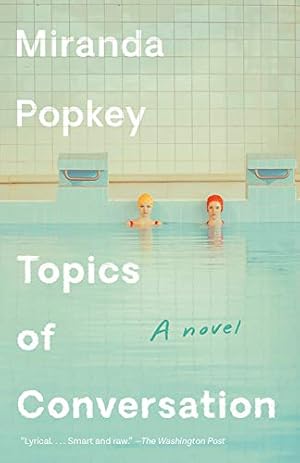
Miranda Popkey's novel Topics of Conversation is inventive in form, compelling, and dazzlingly intelligent.
The New York Times Book Review wrote of the book:
"Sally Rooney-esque. . . . Popkey's sentences careen breathlessly as her halting, staccato prose mirrors the ‘churning’ within the narrator's mind. . . . A shrewd record of the act of unflinchingly circling these amorphous notions of pain, desire and control."
In her words, here is Miranda Popkey's Book Notes music playlist for her debut novel Topics of Conversation:
I have a — I want to say vexed relationship to music, but vexed aspires to a pretension that my relationship to music, such as it is, would be embarrassed by. Say, instead, that I grew up listening to NPR and the BBC, that the two most potent auditory memories from my childhood and adolescence are: one, the live broadcast of the Senate’s roll call vote on the Clinton impeachment (age 11); and, two, the first airing of Episode 259 of “This American Life” (“Promised Land”), specifically Hillary Frank’s Act Three essay, “Mystery Train” (age 16). Say, more simply, that I am terrified of change — yes, even of the key and track variety — and that when I do find a song I love I am liable to put it on repeat for hours, even days on end, the point being to wring all feeling from the feeling it provokes until the notes connote nothing more than the absence of silence.
All of which is to say: I found this task — setting my novel to music — excruciating in the very best way. (They call them growing pains for a reason: it hurts to grow!) Also that I cheated a little by leaning on film soundtracks. Below, I’ve paired each of the nine sections into which my novel is broken with a musical selection. Not sure how well this works as a playlist; I *gritted teeth emoji* mostly listen to podcasts.
“Italy, 2000”: Georges Delerue, “Camille (From “Le mépris” Original Soundtrack Theme”
Delerue’s theme is the melancholic backbone of Jean-Luc Godard’s 1963 film Contempt, and as (deliberately) heavy-handed as the director’s use of the melody can sometimes be, the portentous violins are undeniably stirring — besides which, they fit our narrator’s self-serious mien. I imagine her sitting alone, Artemisia gone and the sun rising, staring at the brightening horizon, strings slowly swelling as the camera moves clockwise until it is behind and above her, until the screen, as in the last shot of Contempt, is empty of all but water and sky and we, the viewers-slash-listeners-slash-readers, feel or remember how it felt to feel the bruised-peach sadness that is the special province of a largely unblemished youth.
“Ann Arbor, 2002”: The Crystals, “He Hit Me (It Felt Like a Kiss)”
A little on the nose, perhaps — the kind of needle drop you’d get in late-period Scorsese or any-period Zemeckis — but it almost plays if you imagine the graduate student hosting the party hearing it come on (they’re listening to the college station, say; or, better, someone stuck it on a party mix — they’re English graduate students, after all, a sick sense of humor is de rigueur), smiling even, just a little, just to herself — and bitter, the smile is bitter — turning it down, claiming the room’s attention, beginning her story.
“San Francisco, 2010”: Carl Orff, “Vier Stück für Xylophon: Gassenhauer nach Hans Neusiedler” (Gunild Keetman, Karl Peinkofer Percussion Ensemble)
I heard this for the first time in college — a version is used in Terrence Malick’s Badlands, and I remember fairly skipping out of the theater, buoyed by the bounce of the xylophone. As light and playful as that xylophone is, the crescendo — the big drums that come in around 1:27 and get to booming around 1:50 — has real meat, meat and teeth to tear in, and also an awful — awe-full — kind of hope: Icarus on his way up, Daedalus, proud, gazing up at him from down below. I imagine the crescendo crescendo-ing as our narrator extends her hand toward the screen at the bottom of the pool: belief reaching, against knowledge, for transcendence.
“Los Angeles, 2011”: Natalie Merchant, “San Andreas Fault”
My hemming and hawing re: early experiences with music aside, this is a song I have distinct memories of listening to over and over, deep into the night, at work on some school assignment I’d started on late and couldn’t bear to turn in imperfect. There’s a thematic rhyme, of course — the San Andreas fault runs just east of Los Angeles; one might speak of figurative fault lines in the narrator’s relationship with both her friend and her parents — but, too, for all the other-worldly beauty of Merchant’s voice, there’s a matter-of-factness about this song, a kind of elemental certainty I want to clobber my narrator over the head with as she power walks her way up the hills of Griffith Park, slipping in and out of the story her friend is telling her, in and out of the truth about her failed marriage, the truth about her unsatisfied and unsatisfying life. Also, and without claiming any kind of serious synesthesia, this song comes to me in the same dun un-color I associate with the trails in Griffith.
“San Francisco, 2012”: Michael Nyman, “Angelfish Decay” and “Time Lapse”
This is almost a joke — imagine putting “Angelfish Decay” on, turning the volume knob clockwise; imagine the camera zooming up and out as our narrator and her gentleman companion start to, you know; imagine the actual sex sped up and silly looking, both to undercut its import — our narrator would hate it if you took anything she did too seriously — and because of course you can’t show sex on film. I say almost because “Angelfish Decay,” like “Time Lapse,” was originally composed for the Peter Greenaway film A Zed and Two Noughts, a film about, among other things, well — decay, and so is a touch more than ever-so-slightly menacing. What I mean is: rewind the tape, cue up “Time Lapse,” and hit play as the gentleman soon-to-be companion sits down at the bar. Play it soft at first; then, gradually, louder. A different effect, no?
“Los Angeles, 2012”: Liz Phair, “Dance of the Seven Veils”
I mean, no, in fact I didn’t cut a scene from this section in which our narrator switches from gin to tequila and puts on Exile in Guyville and tries to sing along — badly, god, so badly — just to the bit where Phair dips in and out of falsetto (“I only ask because I’m a real cunt in spring / you can rent me by the hour”), but, I mean, I could have.
“Fresno, 2014”: Fleetwood Mac, “Albatross”
This plays as our narrator is driving away — somewhat, let’s be honest, somewhat unsteadily — from the mother’s group that, again in the spirit of honesty, was A-of-all never really a group and is B-of-all certainly never meeting again. Arguably a song that soothes, that croons wordlessly of peace and calm in calming, peaceful chords. And it’s not that I hear menace here; I don’t. Actually I don’t hear anything — or rather, I hear nothing, an absence, the numb non-feeling of dumb flesh. It’s what our narrator seeks when she drinks, a return to dumb flesh, and it’s what this song promises.
“Santa Barbara, 2016”: Big Thief, “Masterpiece”
The sun coming up, our narrator getting out of the water, shaking her head, walking toward her clothes — looks, she’s hit rock bottom, we can allow her one moment of tender, hopeful, bedraggled triumph, can’t we?
“San Joaquin Valley, 2017”: Brian Eno, “Here Come the Warm Jets”
This song sounds to me like sex feels: every nerve ending shorting out, distortion cresting, eventually a thin voice, words I won’t remember. I don’t think our narrator will be having sex anytime soon, but I can give her the aural equivalent as she stares out, self-consciously (sure, yes, she raises her hand to her face to shield her eyes from the sun in a gesture that was, even in Eve’s day, already a quotation) over the dusty, dead-end expanse that stretches from the foot of her door to the edge of her sightline. She’s not happy, she’s not even enjoying herself, but if she could hear this song she would, I think, feel a twinge that she too might recognize as pleasure.
Miranda Popkey lives in Massachusetts. Topics of Conversation is her first novel.
If you appreciate the work that goes into Largehearted Boy, please consider making a donation.


